
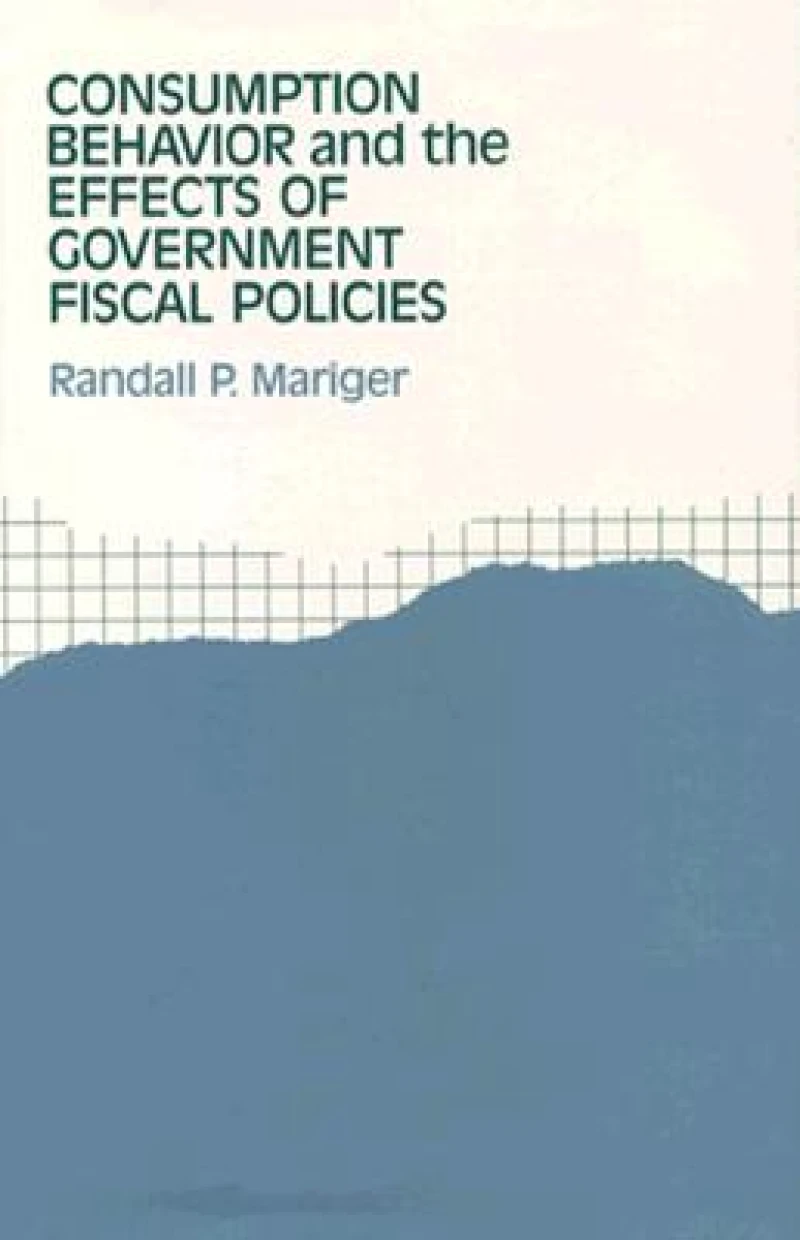
Consumption Behavior and the Effects of Government Fiscal Policies
Book Details
Format
Hardback or Cased Book
Book Series
Harvard Economic Studies
ISBN-10
0674166353
ISBN-13
9780674166356
Publisher
Harvard University Press
Imprint
Harvard University Press
Country of Manufacture
US
Country of Publication
GB
Publication Date
May 20th, 1986
Print length
312 Pages
Weight
635 grams
Dimensions
23.50 x 15.60 x 3.00 cms
Product Classification:
ConsumerismMarket research
Ksh 8,650.00
Temporarily out of stock, due soon
0 in stock
Delivery Location
Delivery fee: Select location
Secure
Quality
Fast
In Consumption Behavior and the Effects of Government Fiscal Policies, Randall Mariger explores how people make decisions about how much to consume and save over their lifetimes. An understanding of these issues illuminates not only individual behavior but important properties of the macro economy as well. The most popular framework for analyzing consumption has been the life-cycle theory. Mariger tests two fundamental, and controversial, assumptions underlying the theory—that there are no planned bequests and that human capital is marketable. To do this, he fits a structural consumption model that incorporates endogenous liquidity constraints (non-marketability of human capital), but no planned bequests, to data on a cross-section of U. S. families. This estimated model, in conjunction with estimates of alternative models, enables him to make inferences about the respective effects of liquidity constraints and social security wealth on consumption. This latter effect yields indirect evidence concerning planned bequests. Mariger also presents direct evidence concerning bequest behavior. Among his findings are that the model fits the data very well in spite of its tight theoretical structure; that liquidity constraints are prevalent and have important effects on consumption behavior; that planned bequests appear not to be common among families in the lower 99.1% of the wealth distribution; and that families in the upper 0.9% of the wealth distribution appear to plan substantial bequests. Mariger devotes the latter part of his book to studying the implications of his estimated consumption model for the effects of government fiscal policies. More specifically, he simulates the model to infer the effects of government tax/debt policy, as well as those of the social security system, on aggregate savings.
Get Consumption Behavior and the Effects of Government Fiscal Policies by at the best price and quality guaranteed only at Werezi Africa's largest book ecommerce store. The book was published by Harvard University Press and it has pages.

