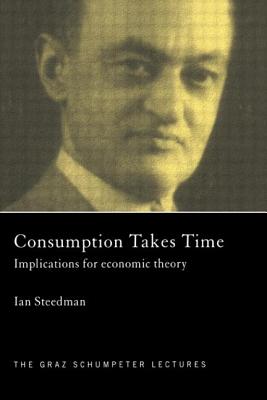
Consumption Takes Time : Implications for Economic Theory
by
Ian Steedman
Book Details
Format
Hardback
Book Series
The Graz Schumpeter Lectures
ISBN-10
0415250994
ISBN-13
9780415250993
Publisher
Taylor & Francis Ltd
Imprint
Routledge
Country of Manufacture
GB
Country of Publication
GB
Publication Date
Mar 29th, 2001
Print length
176 Pages
Weight
433 grams
Product Classification:
ConsumerismConsumerism
KSh 30,950.00
Currently unavailable
0 in stock
Delivery Location
Delivery fee: Select location
Secure
Quality
Fast
This book develops standard economic theories of consumer behaviour to look at the extent to which time constraints are a determinant of consumption.
Standard economic theory of consumer behaviour considers consumers'' preferences, their incomes and commodity prices to be the determinants of consumption. However, consumption takes time and no consumer has more - or less - than 168 hours per week. This simple fact is almost invisible in standard theory, and takes the centre stage in this book. Whether one is ''money-rich but time-poor'' or is ''money-poor and killing time'', both money and time considerations matter.
Recognition that consumers are subject to both time and expenditure constraints makes a real difference to the economic theory of consumption. ''Two-constraint'' theory is genuinely different in various respects from the familiar one-constraint theory. Income effects, substitution effects etc. have to be reconsidered, expenditure functions have to be redefined, and the results are sometimes surprising. It is not only the positive theory of consumption and labour supply that must be reworked, welfare economics too changes significantly when time constraints on consumption are given their proper due. The focus on time not only changes the comparative states of consumer theory, but it also overcomes some of the more artificial barriers between social theory and practical, everyday matters of altruism and interpersonal decision taking.
Recognition that consumers are subject to both time and expenditure constraints makes a real difference to the economic theory of consumption. ''Two-constraint'' theory is genuinely different in various respects from the familiar one-constraint theory. Income effects, substitution effects etc. have to be reconsidered, expenditure functions have to be redefined, and the results are sometimes surprising. It is not only the positive theory of consumption and labour supply that must be reworked, welfare economics too changes significantly when time constraints on consumption are given their proper due. The focus on time not only changes the comparative states of consumer theory, but it also overcomes some of the more artificial barriers between social theory and practical, everyday matters of altruism and interpersonal decision taking.
Get Consumption Takes Time by Ian Steedman at the best price and quality guaranteed only at Werezi Africa's largest book ecommerce store. The book was published by Taylor & Francis Ltd and it has 176 pages.
Customers Who Bought This Also Bought

No Logo
KSh 2,000.00

No Logo 10th Anniversary E
KSh 2,000.00
Enshittification
KSh 3,950.00
Enshittification
KSh 2,000.00
Consumer Kids
KSh 3,800.00

Selling Mrs. Consumer
KSh 17,000.00

Ambivalent Consumer
KSh 20,900.00

Selling Mrs. Consumer
KSh 5,900.00

The Cambridge Handbook of Consumer Psychology
KSh 32,850.00

The Ambivalent Consumer
KSh 5,200.00
Approaching Consumer Culture
KSh 16,200.00

Japanese Consumer Behaviour
KSh 30,950.00