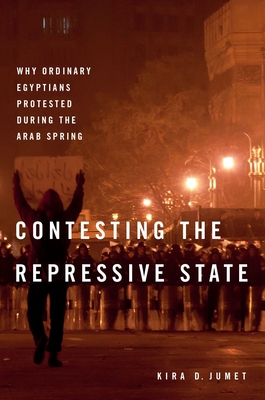
Contesting the Repressive State : Why Ordinary Egyptians Protested During the Arab Spring
Book Details
Format
Paperback / softback
ISBN-10
0190688467
ISBN-13
9780190688462
Publisher
Oxford University Press Inc
Imprint
Oxford University Press Inc
Country of Manufacture
GB
Country of Publication
GB
Publication Date
Dec 7th, 2017
Print length
296 Pages
Weight
454 grams
Dimensions
15.50 x 23.10 x 2.00 cms
Product Classification:
Political ideologiesDemonstrations & protest movementsRevolutionary groups & movements
KSh 7,400.00
Temporarily out of stock, due soon
0 in stock
Delivery Location
Delivery fee: Select location
Secure
Quality
Fast
For years prior to the Arab Spring, opposition activists in Egypt organized protests with limited success. So why and how did thousands of Egyptian citizens suddenly take to the streets against the Mubarak regime in January 2011? Contesting the Repressive State not only answers this question, but asks specifically why and how people who are not part of political movements choose to engage or not engage in anti-government protest under repressive regimes. Ultimately, Kira D. Jumet explores how social media, violent government repression, changes in political opportunities, and the military influenced individual decisions to protest or not protest.
Looking at political mobilization in the years leading up to the 2011 Egyptian Revolution, one can notice a stark disparity between the number of people who participated in online organizing and the number of individuals who protested in the streets. During one silent demonstration organized by the We are all Khaled Said Facebook page in 2010, when the numbers in the streets were limited, one activist posted, "Where are the people who said they were coming? Where are the 10,000 men and women?" For years prior to the Arab Spring, opposition activists in Egypt organized protests with limited success. So why and how did thousands of Egyptian citizens suddenly take to the streets against the Mubarak regime in January 2011? Contesting the Repressive State not only answers this question, but asks specifically why and how people who are not part of political movements choose to engage or not engage in anti-government protest under repressive regimes. The central argument is that individuals are rational actors and their decisions to protest or not protest are based on the intersection of three factors: political opportunity structures, mobilizing structures, and framing processes (or the way in which the media presents particular issues). In turn, specific situations and frames trigger emotion in people, and it is this emotion that drives people to protest. Each chapter looks at a different facet of the revolutionary process (grievances, online participation, media framing, government violence) and identifies a relationship between key structural factors in each and the emotional responses they produce. Contesting the Repressive State is based on 170 interviews conducted in Egypt, during the Arab Spring, both with people who participated in street protests and those who did not. Ultimately, Kira D. Jumet explores how social media, violent government repression, changes in political opportunities, and the military influenced individual decisions to protest or not protest.
Get Contesting the Repressive State by Kira D. Jumet at the best price and quality guaranteed only at Werezi Africa's largest book ecommerce store. The book was published by Oxford University Press Inc and it has 296 pages.
Customers Who Bought This Also Bought

Message
KSh 3,400.00

Is a River Alive?
KSh 2,150.00

Lobbying for Zionism on Both Sides of the Atlantic
KSh 2,700.00

A New World Begins
KSh 3,950.00

Debatable Land
KSh 3,950.00

Capitalism and Freedom
KSh 3,350.00

Capital & Ideology
KSh 3,050.00

Doppelganger
KSh 2,350.00

January 6 and the Politics of History
KSh 4,650.00

Nehru
KSh 2,000.00

Persuaders
KSh 3,600.00

Persuaders
KSh 2,000.00