
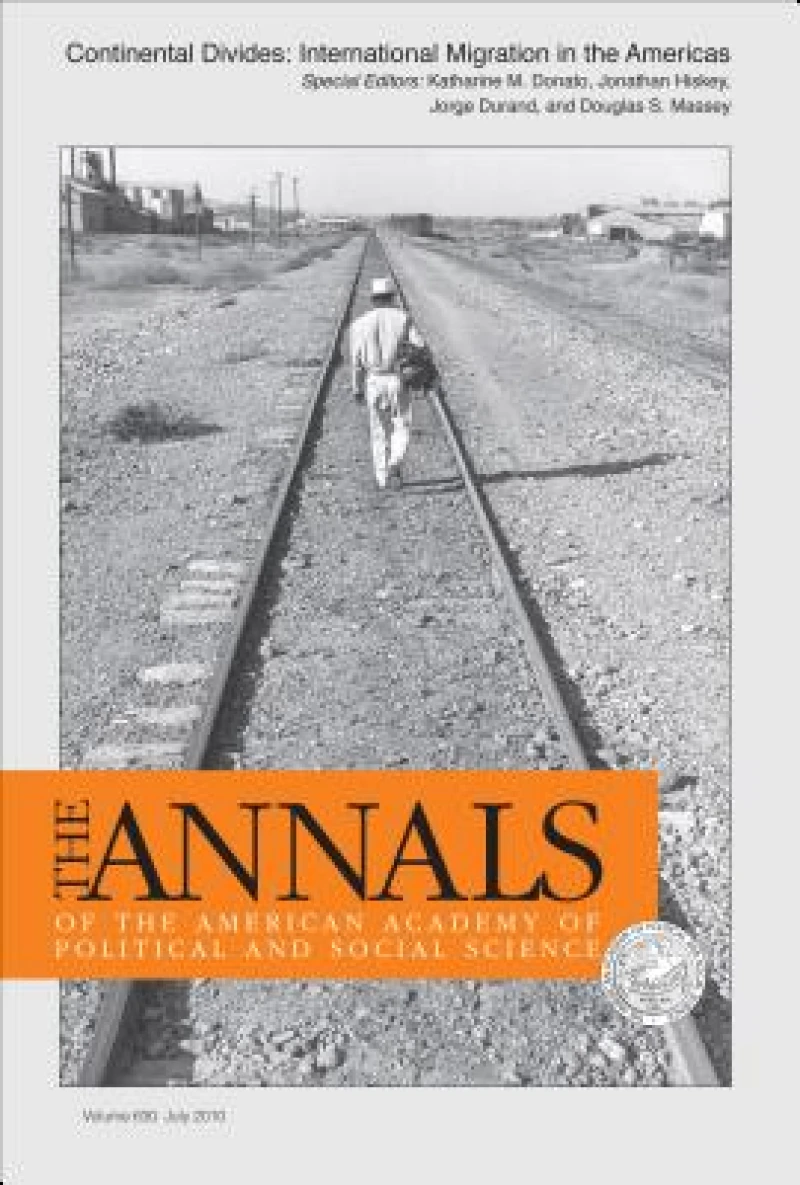
Continental Divides: International Migration in the Americas
Book Details
Delivery Location
Delivery fee: Select location
Since Mexico-U.S. migration represents the largest sustained migratory flow between two nations worldwide, much of the theoretical and empirical work on migration has focused on this single case. In the last few decades, however, migration has emerged as a critical issue across all nations in Latin America and the Caribbean, with the region seeing its position changed from a net migrant-receiving region to one that now stands as one of the foremost sending areas of the world.
In this latest volume of the ANNALS, leading migration scholars seek to redress the imbalance offered when only studying a single case with the first systematic assessment of Latin American migration patterns using ongoing research on the Mexican case as a basis for comparison. Each chapter examines specific propositions or findings derived from the Mexican case that have not yet been tested for other Latin American or Caribbean nations. Using a common framework of data, methods, and theories, they offer a new perspective on the causes and consequences of migration in the Western Hemisphere.
Since Mexico-U.S. migration represents the largest sustained migratory flow between two nations worldwide, much of the theoretical and empirical work on migration has focused on this single case. In the last few decades, however, migration has emerged as a critical issue across all nations in Latin America and the Caribbean, with the region seeing its position changed from a net migrant-receiving region to one that now stands as one of the foremost sending areas of the world.
In this latest volume of the ANNALS, leading migration scholars seek to redress the imbalance offered when only studying a single case with the first systematic assessment of Latin American migration patterns using ongoing research on the Mexican case as a basis for comparison. Each chapter examines specific propositions or findings derived from the Mexican case that have not yet been tested for other Latin American or Caribbean nations. Using a common framework of data, methods, and theories, they offer a new perspective on the causes and consequences of migration in the Western Hemisphere.
The authors examine four fundamental questions: What are the individual determinants and basic processes of movement? How do we identify and understand the larger structural causes that ultimately underlie individual and household decisions to move? What are the consequences of migration for individuals, households, and communities in sending and receiving nations? And what effect do governmental attempts to control the quantity and quality of immigrants have on the actual size and composition of the resulting international flows? Using comparable data from the Mexican Migration Project (MMP) and the Latin American Migration Project (LAMP), the most comprehensive and reliable source of data on immigration from Latin America and the Caribbean, the volume offers valuable insight into 118 Mexican communities and 35 communities from seven other nations of Latin America and the Caribbean, including Costa Rica, Nicaragua, Peru, Paraguay, Argentina, Haiti, and the Dominican Republic, as well as Puerto Rico.
In this volume, comparative research is shown to be critical to building an accurate theoretical and substantive understanding of migration. Through the authors′ findings, we are shown what is possible when researchers are able to draw on a common source of comparable data to study migratory decision-making and outcomes across diverse origin countries. Specific outcomes help the authors to identify: common characteristics of pioneer migrants; gender effects on migration; the role that political shocks and violence can play in promoting emigration during times of political and economic transition; differences in the education profiles of emigrants from Latin American countries that lie at different ends of the migrant selectivity continuum; the important influence of remittances sent home by migrants and the migrants′ occupational prospects once they return home; and the effect of U.S. immigration policies on the behavior and characteristics of immigrants.
This comparative approach to the study of migration represents a unique and innovative contribution to scholarship on international migration—a topic of considerable interest in the twenty-first century. Political scientists, sociologists, and policy-makers will find much value in these compelling and timely readings. For all social scientists who are interested in ethnic studies and migration, this volume provides inspiration for future research.
Get Continental Divides: International Migration in the Americas by at the best price and quality guaranteed only at Werezi Africa's largest book ecommerce store. The book was published by SAGE Publications Inc and it has pages.

