
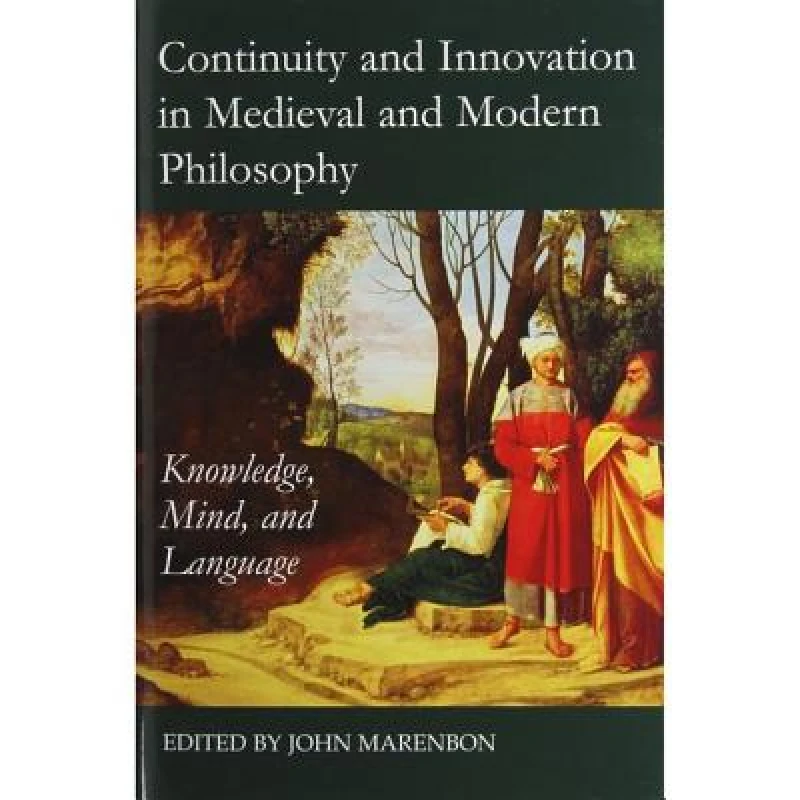
Continuity and Innovation in Medieval and Modern Philosophy : Knowledge, Mind and Language
Book Details
Format
Hardback or Cased Book
Book Series
Proceedings of the British Academy
ISBN-10
0197265499
ISBN-13
9780197265499
Publisher
Oxford University Press
Imprint
Oxford University Press
Country of Manufacture
GB
Country of Publication
GB
Publication Date
Aug 22nd, 2013
Print length
150 Pages
Weight
444 grams
Dimensions
24.20 x 17.60 x 2.00 cms
Product Classification:
Western philosophy: Medieval & Renaissance, c 500 to c 1600Islamic & Arabic philosophy
Ksh 7,200.00
Werezi Extended Catalogue
0 in stock
Delivery Location
Delivery fee: Select location
Secure
Quality
Fast
The usual division of philosophy into 'medieval' and 'modern' may obscure very real continuities in the ideas of thinkers in the western and Islamic traditions. This book examines three areas where these continuities are particularly clear: knowledge, the mind, and language.
The usual division of philosophy into ''medieval'' and ''modern'' may obscure very real continuities in the ideas of thinkers in the western and Islamic traditions. This book examines three areas where these continuities are particularly clear: knowledge, the mind, and language. Dominik Perler shows how, when Descartes attacked faculty psychology, he was indeed separating himself from one strand of the medieval tradition, represented by Suárez, but at the same time he was closely following another strand, found in Ockham. Martin Lenz shows how Locke''s philosophy of language fits into a long medieval tradition of thought based on Aristotle''s On Interpretation. Locke introduced the requirement that a word be linked to an idea in the speaker''s mind, but Lenz argues that this does not mean that Locke was proposing that we each have a private language. Robert Pasnau looks at an area where the continuity between the attitudes of, for instance, Aquinas and Locke contrasts with views generally held in Islam and among Jewish thinkers. Whereas Latin thinkers rarely defended the idea that some knowledge should be kept for the elite, this view was held by al-Ghazâlî, Averroes and Maimonides - and it may, he argues, be a defensible philosophical position today. The chapters are based on papers given at a symposium at the British Academy and are presented here with responses by Andrew Pyle, Michael Ayers and John Hawthorne.
Get Continuity and Innovation in Medieval and Modern Philosophy by at the best price and quality guaranteed only at Werezi Africa's largest book ecommerce store. The book was published by Oxford University Press and it has pages.

