
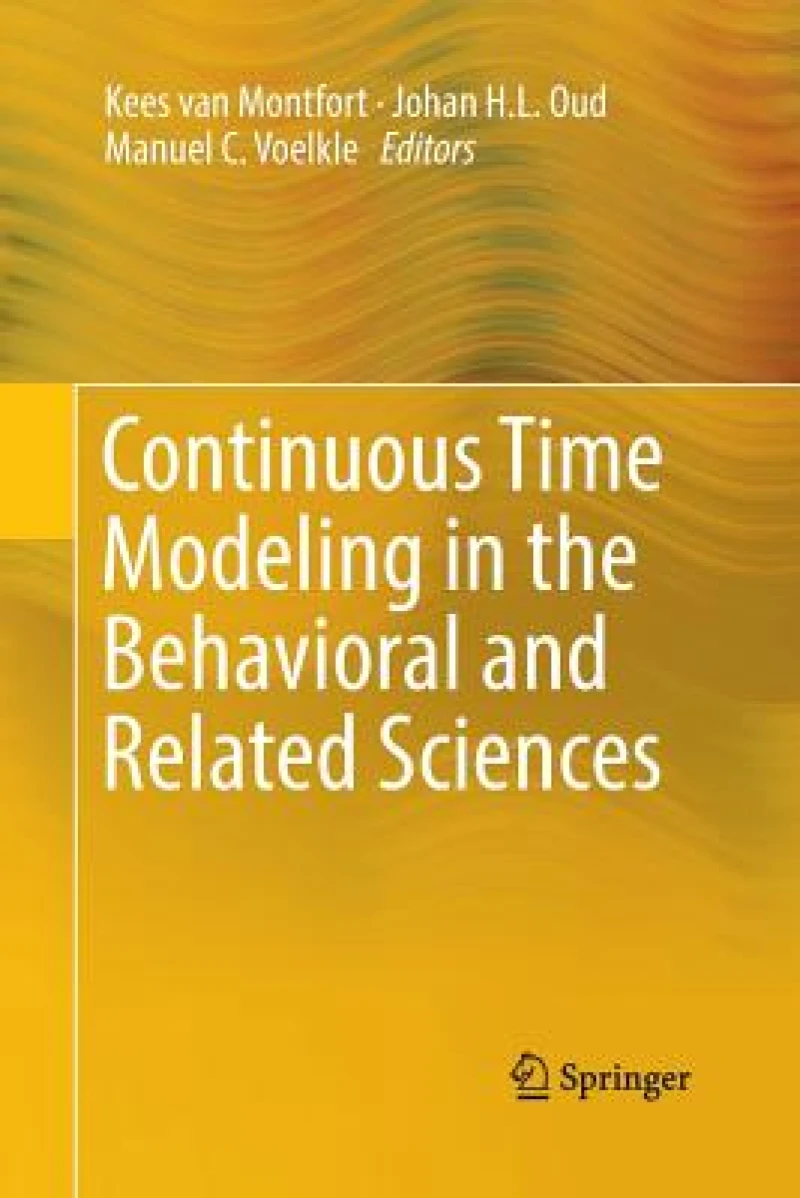
Continuous Time Modeling in the Behavioral and Related Sciences
Softcover Reprint of the Original 1st 2018 ed.
Book Details
Format
Paperback / Softback
ISBN-10
3030084019
ISBN-13
9783030084011
Edition
Softcover Reprint of the Original 1st 2018 ed.
Publisher
Springer Nature Switzerland AG
Imprint
Springer Nature Switzerland AG
Country of Manufacture
GB
Country of Publication
GB
Publication Date
Jan 24th, 2019
Print length
442 Pages
Ksh 14,400.00
Werezi Extended Catalogue
0 in stock
Delivery Location
Delivery fee: Select location
Secure
Quality
Fast
This unique book provides an overview of continuous time modeling in the behavioral and related sciences. In 16 chapters, the book addresses a vast range of topics in continuous time modeling, from approaches that closely mimic traditional linear discrete time models to highly nonlinear state space modeling techniques.
This unique book provides an overview of continuous time modeling in the behavioral and related sciences. It argues that the use of discrete time models for processes that are in fact evolving in continuous time produces problems that make their application in practice highly questionable. One main issue is the dependence of discrete time parameter estimates on the chosen time interval, which leads to incomparability of results across different observation intervals. Continuous time modeling by means of differential equations offers a powerful approach for studying dynamic phenomena, yet the use of this approach in the behavioral and related sciences such as psychology, sociology, economics and medicine, is still rare. This is unfortunate, because in these fields often only a few discrete time (sampled) observations are available for analysis (e.g., daily, weekly, yearly, etc.). However, as emphasized by Rex Bergstrom, the pioneer of continuous-time modeling in econometrics, neitherhuman beings nor the economy cease to exist in between observations. In 16 chapters, the book addresses a vast range of topics in continuous time modeling, from approaches that closely mimic traditional linear discrete time models to highly nonlinear state space modeling techniques. Each chapter describes the type of research questions and data that the approach is most suitable for, provides detailed statistical explanations of the models, and includes one or more applied examples. To allow readers to implement the various techniques directly, accompanying computer code is made available online. The book is intended as a reference work for students and scientists working with longitudinal data who have a Master's- or early PhD-level knowledge of statistics.
Get Continuous Time Modeling in the Behavioral and Related Sciences by at the best price and quality guaranteed only at Werezi Africa's largest book ecommerce store. The book was published by Springer Nature Switzerland AG and it has pages.

