
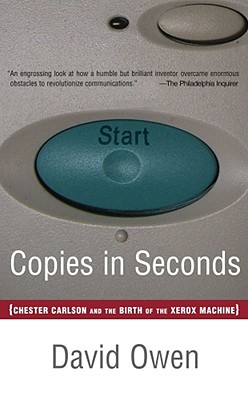
Copies in Seconds : How a Lone Inventor and an Unknown Company Created the Biggest Communication Breakthrough Since Gutenberg--Chester Carlson and the Birth of Xerox
by
David Owen
Book Details
Format
Paperback / softback
ISBN-10
0743251180
ISBN-13
9780743251181
Publisher
Simon & Schuster
Imprint
Simon & Schuster
Country of Manufacture
GB
Country of Publication
GB
Publication Date
May 9th, 2005
Print length
320 Pages
Weight
422 grams
Dimensions
14.10 x 21.60 x 2.40 cms
Product Classification:
Office & workplaceOffice and workplace
KSh 3,950.00
Currently unavailable
0 in stock
Delivery Location
Delivery fee: Select location
Secure
Quality
Fast
A history of the photocopier offers a portrait of reserved physics graduate Chester Carlson.
A lone inventor and the story of how one of the most revolutionary inventions of the twentieth century almost didn''t happen.
Introduced in 1960, the first plain-paper office copier is unusual among major high-technology inventions in that its central process was conceived by a single person. Chester Carlson grew up in unspeakable poverty, worked his way through junior college and the California Institute of Technology, and made his discovery in solitude in the depths of the Great Depression. He offered his big idea to two dozen major corporations -- among them IBM, RCA, and General Electric -- all of which turned him down. So persistent was this failure of capitalistic vision that by the time the Xerox 914 was manufactured, by an obscure photographic-supply company in Rochester, New York, Carlson''s original patent had expired.
Xerography was so unusual and nonintuitive that it conceivably could have been overlooked entirely. Scientists who visited the drafty warehouses where the first machines were built sometimes doubted that Carlson''s invention was even theoretically feasible. Building the first plain-paper office copier -- with parts scrounged from junkyards, cleaning brushes made of hand-sewn rabbit fur, and a built-in fire extinguisher -- required the persistence, courage, and imagination of an extraordinary group of physicists, engineers, and corporate executives whose story has never before been fully told.
Copies in Seconds is a tale of corporate innovation and risk-taking at its very best.
Introduced in 1960, the first plain-paper office copier is unusual among major high-technology inventions in that its central process was conceived by a single person. Chester Carlson grew up in unspeakable poverty, worked his way through junior college and the California Institute of Technology, and made his discovery in solitude in the depths of the Great Depression. He offered his big idea to two dozen major corporations -- among them IBM, RCA, and General Electric -- all of which turned him down. So persistent was this failure of capitalistic vision that by the time the Xerox 914 was manufactured, by an obscure photographic-supply company in Rochester, New York, Carlson''s original patent had expired.
Xerography was so unusual and nonintuitive that it conceivably could have been overlooked entirely. Scientists who visited the drafty warehouses where the first machines were built sometimes doubted that Carlson''s invention was even theoretically feasible. Building the first plain-paper office copier -- with parts scrounged from junkyards, cleaning brushes made of hand-sewn rabbit fur, and a built-in fire extinguisher -- required the persistence, courage, and imagination of an extraordinary group of physicists, engineers, and corporate executives whose story has never before been fully told.
Copies in Seconds is a tale of corporate innovation and risk-taking at its very best.
Get Copies in Seconds by David Owen at the best price and quality guaranteed only at Werezi Africa's largest book ecommerce store. The book was published by Simon & Schuster and it has 320 pages.
Customers Who Bought This Also Bought

Time-Block Planner
KSh 3,050.00

From Strength to Strength
KSh 2,000.00
Now Lead the Change
KSh 2,900.00
The Black O – Racism and Redemption in an American Corporate Empire
KSh 5,450.00

Unsuspecting Valentine
KSh 2,050.00

Reckonings
KSh 3,600.00

Practice Standard for Work Breakdown Structures - Third Edition
KSh 9,550.00
Making Social Technologies Work
KSh 4,150.00

Just Work
KSh 3,600.00
Reinventing the Workplace
KSh 3,800.00

No Fail Trust
KSh 3,800.00

Kirchengemeinde - Sozialsystem im Wandel
KSh 31,750.00
More by David Owen

South Wales Collieries Volume 3
KSh 2,700.00

Time to Declare
KSh 3,350.00

Hit & Hope
KSh 2,850.00

Key Skills for Housing Adaptations
KSh 5,250.00

Alex Neptune, Pirate Hunter
KSh 1,450.00

First National Bank of Dad
KSh 2,700.00

Graveyard Gladiators
KSh 1,600.00

Hubris - The Road to Donald Trump
KSh 3,650.00

Hubris
KSh 3,200.00

Where the Water Goes
KSh 2,500.00
Cwm Rhondda Fach
KSh 2,700.00
Cabinet's Finest Hour
KSh 2,700.00
