
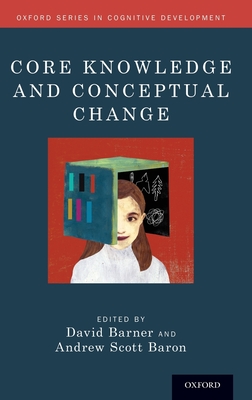
Core Knowledge and Conceptual Change
Book Details
Format
Hardback
Book Series
Oxford Series in Cognitive Development
ISBN-10
0190467630
ISBN-13
9780190467630
Publisher
Oxford University Press Inc
Imprint
Oxford University Press Inc
Country of Manufacture
US
Country of Publication
GB
Publication Date
Sep 8th, 2016
Print length
408 Pages
Weight
680 grams
Dimensions
16.90 x 24.20 x 3.60 cms
Product Classification:
Child & developmental psychologyCognition & cognitive psychologyLearning
KSh 19,600.00
Temporarily out of stock, due soon
0 in stock
Delivery Location
Delivery fee: Select location
Secure
Quality
Fast
Are humans born good? Or do children learn to be moral? Where do concepts like "democracy" and "atom" come from? This volume documents ground-breaking answers to these questions from developmental psychology, including new science on language, morality, causal explanation, and children's understanding of time, numbers, and other minds.
We acquire concepts such as "atom," "force," "integer," and "democracy" long after we are born; these concepts are not part of the initial cognitive state of human beings. Other concepts like "object," "cause," or "agent" may be present early in infancy--if not innately. Processes of change occur throughout our conceptual development, which prompts two key questions: Which human concepts constitute innate, core knowledge? How do humans acquire new concepts, and how do these concepts change in development?Core Knowledge and Conceptual Change provides a unique theoretical and empirical introduction to the study of conceptual development, documenting key advances in case studies, including ground-breaking science on human representations of language, objects, number, events, color, space, time, beliefs, and desires. Additionally, it explores how humans engage in moral reasoning and causal explanation: Are humans born good and tainted by an imperfect world, or do we need to teach children to be moral? Could a concept like "freedom" be woven into the human soul, or is it a historical invention, constructed over generations of humans? Written by an eminent list of contributors renowned in child development and cognitive science, this book delves widely, and deeply, into the cognitive tools available at birth that are repurposed, combined, and transformed to complex, abstract adult conceptual representations, and should be of interest to developmental psychologists, linguists, philosophers, and students of cognitive science.
Get Core Knowledge and Conceptual Change by Andrew Scott Baron at the best price and quality guaranteed only at Werezi Africa's largest book ecommerce store. The book was published by Oxford University Press Inc and it has 408 pages.
Customers Who Bought This Also Bought

The Anxious Generation
KSh 2,000.00
Restoring Childhood
KSh 3,050.00

Bible old testament bindup_8x8
KSh 2,450.00
The Einstein Syndrome
KSh 3,200.00
Restoring Childhood
KSh 4,500.00
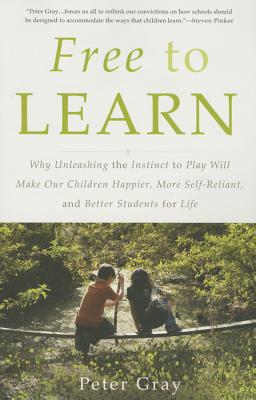
Free to Learn
KSh 3,050.00
Key Issues in Childhood and Youth Studies
KSh 8,000.00
Key Issues in Childhood and Youth Studies
KSh 30,950.00
Outsmart Anxiety
KSh 4,700.00
How Children Succeed
KSh 3,400.00
Helping Children Succeed
KSh 3,050.00
The Life and Creative Works of Paulo Coelho
KSh 21,600.00
