
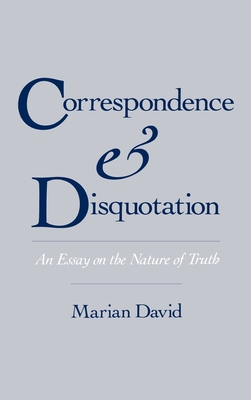
Correspondence and Disquotation : An Essay on the Nature of Truth
by
Marian David
Book Details
Format
Hardback
ISBN-10
0195079248
ISBN-13
9780195079241
Publisher
Oxford University Press Inc
Imprint
Oxford University Press Inc
Country of Manufacture
GB
Country of Publication
GB
Publication Date
Aug 18th, 1994
Print length
216 Pages
Weight
426 grams
Dimensions
21.60 x 14.40 x 2.10 cms
Product Classification:
Philosophy: epistemology & theory of knowledge
KSh 23,350.00
Temporarily out of stock, due soon
0 in stock
Delivery Location
Delivery fee: Select location
Secure
Quality
Fast
Marian David defends the correspondence theory of truth by contrasting it with the disquotational theory of truth, its current major rival. He develops the disquotational theory in rich detail - more than has been available in previous literature - to demonstrate that it is not a tenable theory of truth, as it has too many absurd consequences.
Marian David defends the correspondence theory of truth against the disquotational theory of truth, its current major rival. The correspondence theory asserts that truth is a philosophically rich and profound notion which needs serious explanation. Disquotationalism is a radically deflationary philosophy of truth inspired by Tarski and propagated by Quine and others. It rejects the correspondence theory, insists truth is anemic, and advances an "anti-theory" of truth that is essentially a collection of platitudes: "Snow is white" is true only if snow is actually white; "Grass is green" is true only if grass is actually green. According to disquotationalists the only profound insight about truth is that it lacks profundity. David contrasts the correspondence theory with disquotationalism and then develops the latter position in rich detail - more than has been available in previous literature - to show its faults. He demonstrates that disquotationalism is not a tenable theory of truth, as it has too many absurd consequences.
Get Correspondence and Disquotation by Marian David at the best price and quality guaranteed only at Werezi Africa's largest book ecommerce store. The book was published by Oxford University Press Inc and it has 216 pages.
Customers Who Bought This Also Bought

A Treatise of Human Nature
KSh 2,700.00
Critique of Pure Reason
KSh 3,400.00

Sensuous Knowledge
KSh 4,500.00

Critique of Pure Reason, Abridged
KSh 3,600.00
Sharing Thoughts
KSh 17,000.00

The Critique of Pure Reason
KSh 6,450.00

Critique of Pure Reason
KSh 7,250.00
An Inquiry Into Meaning and Truth
KSh 3,750.00
Intelligence and Spirit
KSh 5,750.00
The Social Construction of What?
KSh 5,200.00
Discourse on Method and Related Writings
KSh 2,000.00
Beyond Good and Evil
KSh 2,000.00
