
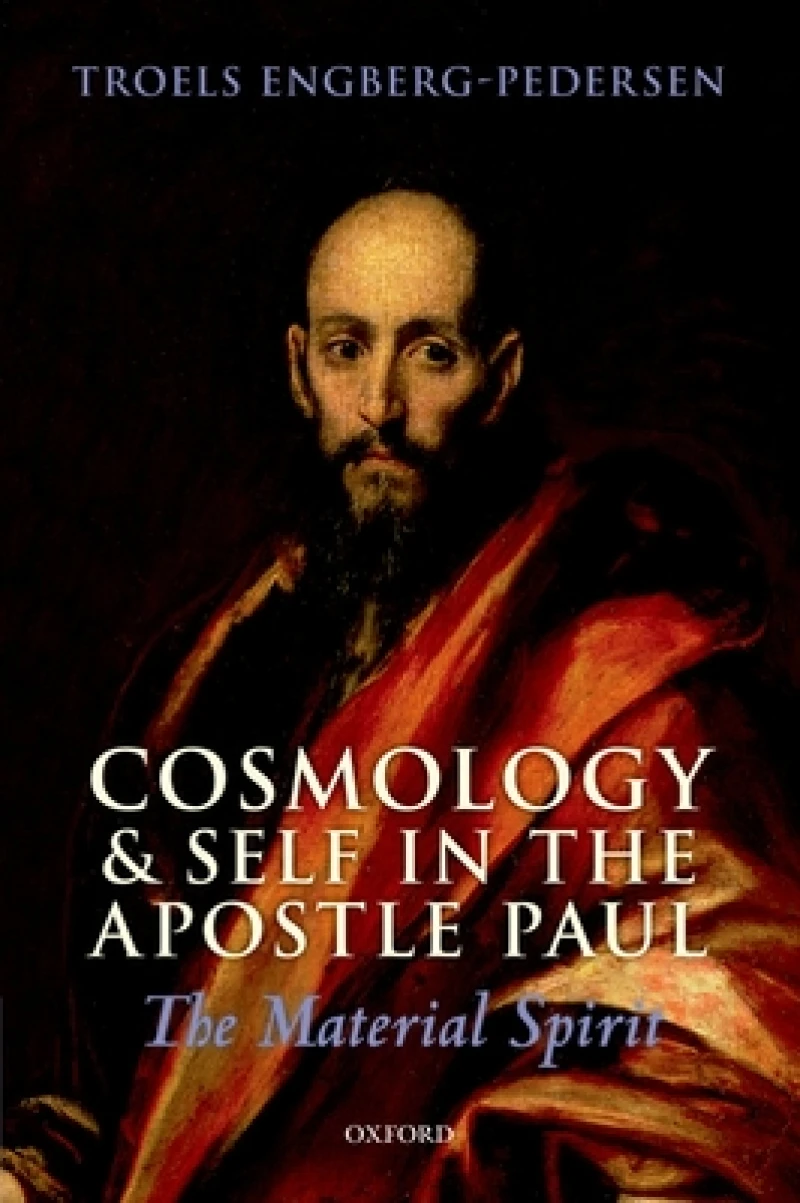
Cosmology and Self in the Apostle Paul : The Material Spirit
Book Details
Format
Paperback / Softback
ISBN-10
0199596743
ISBN-13
9780199596744
Publisher
Oxford University Press
Imprint
Oxford University Press
Country of Manufacture
GB
Country of Publication
GB
Publication Date
Nov 4th, 2010
Print length
304 Pages
Weight
474 grams
Dimensions
23.40 x 15.90 x 1.70 cms
Product Classification:
Western philosophy: Ancient, to c 500Philosophy of religionChristian theology
Ksh 11,150.00
Manufactured on Demand
0 in stock
Delivery Location
Delivery fee: Select location
Secure
Quality
Fast
This book presents an innovative challenge to the traditional reading of Paul. Troels Engberg-Pedersen argues that the usual, mainly cognitive and metaphorical ways of understanding central Pauline concepts must be supplemented by a literal understanding that directly reflects Paul's materialist cosmology.
Cosmology and Self in the Apostle Paul challenges the traditional reading of Paul. Troels Engberg-Pedersen argues that the usual, mainly cognitive and metaphorical, ways of understanding central Pauline concepts, such as ''being in Christ'', ''having God''s pneuma (spirit), Christ''s pneuma, and Christ himself in one'', must be supplemented by a literal understanding that directly reflects Paul''s cosmology. Engberg-Pedersen shows that Paul''s cosmology, not least his understanding of the pneuma, was a materialist, bodily one: the pneuma was a physical element that would at the resurrection act directly on the ordinary human bodies of believers and transform them into ''pneumatic bodies''. This literal understanding of the future events is then traced back to the Pauline present as Engberg-Pedersen considers how Paul conceived in bodily terms of a range of central themes like his own conversion, his mission, the believers'' reception of the pneuma in baptism, and the way the apostle took the pneuma to inform his own and their ways of life from the beginning to the projected end. In developing this picture of Paul''s world view, an explicitly philosophically oriented form of interpretation (''philosophical exegesis'') is employed, in which the interpreter applies categories of interpretation that make sense philosophically, whether in an ancient or a modern context. For this enterprise Engberg-Pedersen draws in particular on ancient Stoic materialist and monistic physics and cosmology - as opposed to the Platonic, immaterialist and dualistic categories that underlie traditional readings of Paul - and on modern ideas on ''religious experience'', ''self'', ''body'' and ''practice'' derived from Foucault and Bourdieu. In this way Paul is shown to have spelled out philosophically his Jewish, ''apocalyptic'' world view, which remains a central feature of his thought. The book states the cosmological case for the author''s earlier ''ethical'' reading of Paul in his prize-winning book, Paul and the Stoics (2000).
Get Cosmology and Self in the Apostle Paul by at the best price and quality guaranteed only at Werezi Africa's largest book ecommerce store. The book was published by Oxford University Press and it has pages.

