
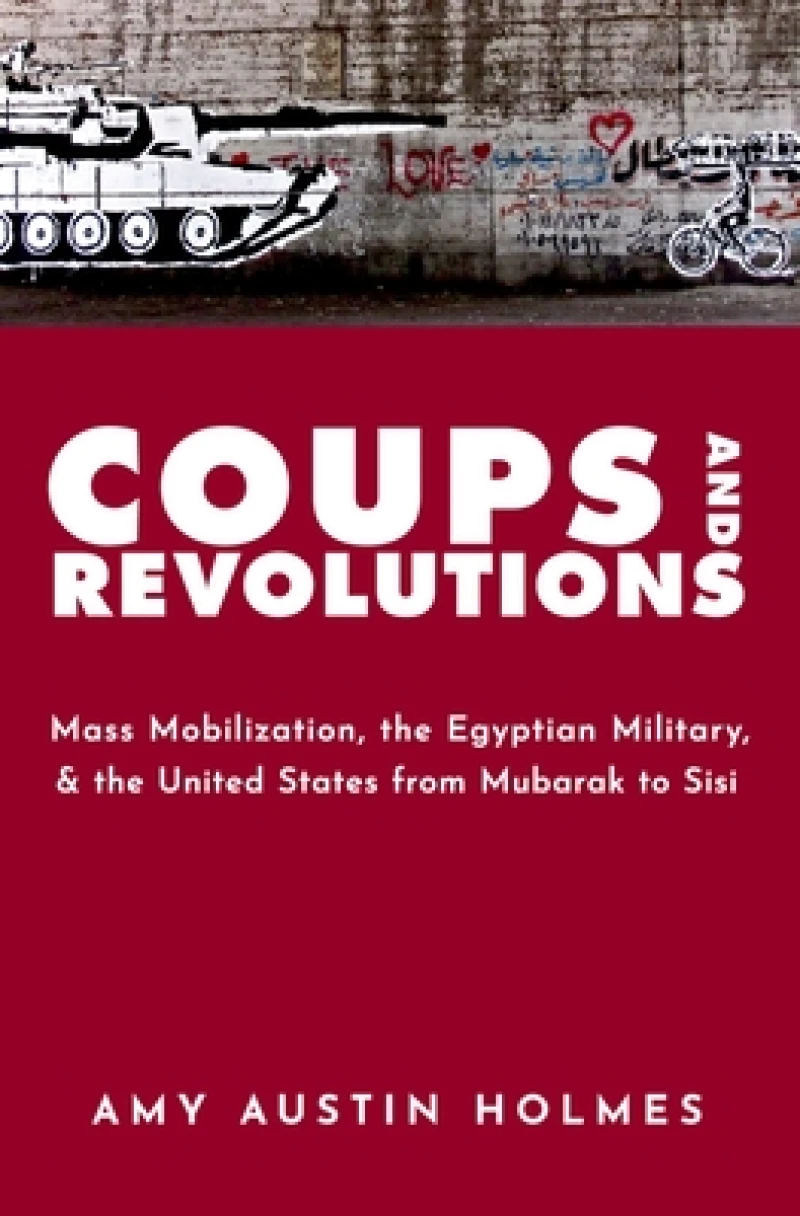
Coups and Revolutions : Mass Mobilization, the Egyptian Military, and the United States from Mubarak to Sisi
Book Details
Format
Paperback / Softback
ISBN-10
0197585809
ISBN-13
9780197585801
Publisher
Oxford University Press Inc
Imprint
Oxford University Press Inc
Country of Manufacture
US
Country of Publication
GB
Publication Date
Oct 5th, 2021
Print length
408 Pages
Weight
599 grams
Dimensions
15.20 x 23.40 x 2.00 cms
Product Classification:
Social & political philosophySociety & culture: generalGeopolitics
Ksh 6,150.00
Temporarily out of stock, due soon
0 in stock
Delivery Location
Delivery fee: Select location
Secure
Quality
Fast
In 2011, Egypt witnessed more protests than any other country in the world: the beginning of a revolutionary process that would unfold in three waves of revolution, followed by two waves of counterrevolution. In addition to providing new and unprecedented empirical data, the book makes two theoretical contributions. First, a new framework is presented for analyzing the state apparatus in Egypt that is based on four pillars of regime support which can either prop up or press upon whoever is in power: the Egyptian military, the business elite, the United States, and the multi-headed opposition. Secondly, the book brings together the literature on bottom-up revolutionary movements and top-down military coups, and introduces the concept of a coup from below in contrast to the revolution from above that took place under Gamal Abdel Nasser.
In 2011, Egypt witnessed more protests than any other country in the world. Counter to the received narrative, Amy Austin Holmes argues that the ousting of Mubarak in 2011 did not represent the culmination of a revolution or the beginning of a transition period, but rather the beginning of a revolutionary process that would unfold in three waves, followed by two waves of counterrevolution. This book offers the first analysis of both the revolution and counterrevolution in Egypt from January 2011 until June 2018. The period of revolutionary upheaval played out in three uprisings against three distinct forms of authoritarian rule: the Mubarak regime and the police state that protected it, the unelected military junta known as the Supreme Council of Armed Forces, and the religious authoritarianism of the Muslim Brotherhood. The counterrevolution occurred over two periods: the first under Adly Mansour as interim president and the second after El Sisi was elected president. While the regime imprisoned or killed the leadership of the Muslim Brotherhood and many secular activists during the first wave of the counterrevolution, it turned against civil society at large during the second: NGOs, charities, media, academia, and minority groups. In addition to providing new and unprecedented empirical data, Coups and Revolutions makes two theoretical contributions. First, it presents a new framework for analyzing the state apparatus in Egypt based on four pillars of regime support that can either prop up or press upon whoever is in power. These are the Egyptian military, the business elite, the United States, and the multi-headed opposition. Secondly, the book brings together the literature on bottom-up revolutionary movements and top-down military coups, and it introduces the concept of a coup from below in contrast to the revolution from above that took place under Gamal Abdel Nasser.
Get Coups and Revolutions by at the best price and quality guaranteed only at Werezi Africa's largest book ecommerce store. The book was published by Oxford University Press Inc and it has pages.

