
Cart 0
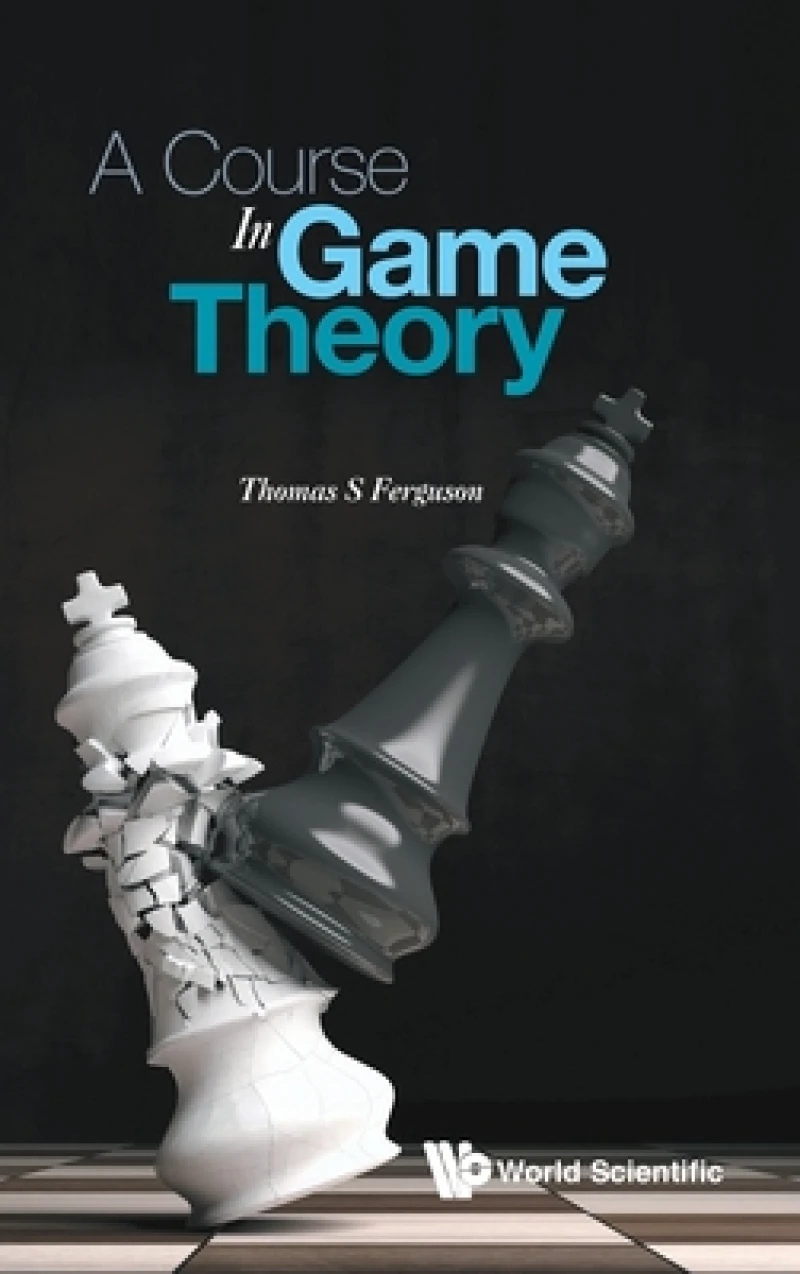
Course In Game Theory, A
Click to zoom

Share this book

Course In Game Theory, A

Book Details

Format Hardback or Cased Book
ISBN-10 9813227346
ISBN-13 9789813227347
Publisher World Scientific Publishing Co Pte Ltd
Imprint World Scientific Publishing Co Pte Ltd
Country of Manufacture GB
Country of Publication GB
Publication Date Aug 4th, 2020
Print length 408 Pages
Weight 746 grams
Dimensions 15.90 x 23.60 x 3.30 cms
Product Classification: Game theory
Ksh 14,400.00
Werezi Extended Catalogue Delivery in 14 days

Delivery Location

Delivery fee: Select location

Delivery in 14 days

Secure
Quality
Fast
Game theory is a fascinating subject. We all know many entertaining games, such as chess, poker, tic-tac-toe, bridge, baseball, computer games — the list is quite varied and almost endless. In addition, there is a vast area of economic games, discussed in Myerson (1991) and Kreps (1990), and the related political games [Ordeshook (1986), Shubik (1982), and Taylor (1995)]. The competition between firms, the conflict between management and labor, the fight to get bills through congress, the power of the judiciary, war and peace negotiations between countries, and so on, all provide examples of games in action. There are also psychological games played on a personal level, where the weapons are words, and the payoffs are good or bad feelings [Berne (1964)]. There are biological games, the competition between species, where natural selection can be modeled as a game played between genes [Smith (1982)]. There is a connection between game theory and the mathematical areas of logic and computer science. One may view theoretical statistics as a two-person game in which nature takes the role of one of the players, as in Blackwell and Girshick (1954) and Ferguson (1968).Games are characterized by a number of players or decision makers who interact, possibly threaten each other and form coalitions, take actions under uncertain conditions, and finally receive some benefit or reward or possibly some punishment or monetary loss. In this text, we present various mathematical models of games and study the phenomena that arise. In some cases, we will be able to suggest what courses of action should be taken by the players. In others, we hope simply to be able to understand what is happening in order to make better predictions about the future.

Game theory is a fascinating subject. We all know many entertaining games, such as chess, poker, tic-tac-toe, bridge, baseball, computer games — the list is quite varied and almost endless. In addition, there is a vast area of economic games, discussed in Myerson (1991) and Kreps (1990), and the related political games [Ordeshook (1986), Shubik (1982), and Taylor (1995)]. The competition between firms, the conflict between management and labor, the fight to get bills through congress, the power of the judiciary, war and peace negotiations between countries, and so on, all provide examples of games in action. There are also psychological games played on a personal level, where the weapons are words, and the payoffs are good or bad feelings [Berne (1964)]. There are biological games, the competition between species, where natural selection can be modeled as a game played between genes [Smith (1982)]. There is a connection between game theory and the mathematical areas of logic and computer science. One may view theoretical statistics as a two-person game in which nature takes the role of one of the players, as in Blackwell and Girshick (1954) and Ferguson (1968).

Games are characterized by a number of players or decision makers who interact, possibly threaten each other and form coalitions, take actions under uncertain conditions, and finally receive some benefit or reward or possibly some punishment or monetary loss. In this text, we present various mathematical models of games and study the phenomena that arise. In some cases, we will be able to suggest what courses of action should be taken by the players. In others, we hope simply to be able to understand what is happening in order to make better predictions about the future.


Get Course In Game Theory, A by at the best price and quality guaranteed only at Werezi Africa's largest book ecommerce store. The book was published by World Scientific Publishing Co Pte Ltd and it has pages.


Mind, Body, & Spirit

Price

Ksh 14,400.00

Shopping Cart

Africa largest book store

Sub Total:
Ebooks

Digital Library
Coming Soon

Our digital collection is currently being curated to ensure the best possible reading experience on Werezi. We'll be launching our Ebooks platform shortly.