
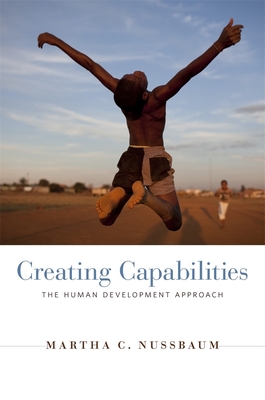
Creating Capabilities – The Human Development Approach : The Human Development Approach
Book Details
Format
Paperback / softback
ISBN-10
0674072359
ISBN-13
9780674072350
Publisher
Harvard University Press
Imprint
The Belknap Press
Country of Manufacture
US
Country of Publication
GB
Publication Date
May 13th, 2013
Print length
256 Pages
Weight
238 grams
Dimensions
21.00 x 15.40 x 1.80 cms
KSh 3,250.00
Publisher Out of Stock
0 in stock
Delivery Location
Delivery fee: Select location
Secure
Quality
Fast
This is a primer on the Capabilities Approach, Martha Nussbaum’s innovative model for assessing human progress. She argues that much humanitarian policy today violates basic human values; instead, she offers a unique means of redirecting government and development policy toward helping each of us lead a full and creative life.
If a country’s Gross Domestic Product increases each year, but so does the percentage of its people deprived of basic education, health care, and other opportunities, is that country really making progress? If we rely on conventional economic indicators, can we ever grasp how the world’s billions of individuals are really managing?In this powerful critique, Martha Nussbaum argues that our dominant theories of development have given us policies that ignore our most basic human needs for dignity and self-respect. For the past twenty-five years, Nussbaum has been working on an alternate model to assess human development: the Capabilities Approach. She and her colleagues begin with the simplest of questions: What is each person actually able to do and to be? What real opportunities are available to them? The Capabilities Approach to human progress has until now been expounded only in specialized works. Creating Capabilities, however, affords anyone interested in issues of human development a wonderfully lucid account of the structure and practical implications of an alternate model. It demonstrates a path to justice for both humans and nonhumans, weighs its relevance against other philosophical stances, and reveals the value of its universal guidelines even as it acknowledges cultural difference. In our era of unjustifiable inequity, Nussbaum shows how—by attending to the narratives of individuals and grasping the daily impact of policy—we can enable people everywhere to live full and creative lives.
Get Creating Capabilities – The Human Development Approach by Martha C. Nussbaum at the best price and quality guaranteed only at Werezi Africa's largest book ecommerce store. The book was published by Harvard University Press and it has 256 pages.
Customers Who Bought This Also Bought
Xmeditations
KSh 700.00
Groundwork for the Metaphysics of Morals
KSh 2,000.00

On the Genealogy of Morals
KSh 2,000.00

Beyond Good and Evil
KSh 2,000.00

The Nicomachean Ethics
KSh 1,600.00

The Sovereignty of Good
KSh 5,400.00

Justice
KSh 2,000.00

Meditations
KSh 1,600.00

What We Owe The Future
KSh 2,000.00

The Analects
KSh 2,350.00
How to Be a Leader – An Ancient Guide to Wise Leadership
KSh 2,800.00

There Are Places in the World Where Rules Are Less Important Than Kindness
KSh 3,600.00
More by Martha C. Nussbaum
Philosophical Interventions
KSh 9,000.00

The Republic of Love
KSh 4,650.00

The Monarchy of Fear
KSh 3,400.00

Not for Profit – Why Democracy Needs the Humanities
KSh 2,700.00

Love's Knowledge
KSh 11,050.00
Political Emotions – Why Love Matters for Justice
KSh 4,650.00

The Tenderness of Silent Minds
KSh 4,000.00
Frontiers of Justice – Disability, Nationality, Species Membership (OIP)
KSh 4,650.00

Citadels of Pride – Sexual Abuse, Accountability, and Reconciliation
KSh 4,000.00

Justice for Animals
KSh 2,350.00

Hiding from Humanity – Disgust, Shame, and the Law
KSh 7,200.00
Women and Human Development
KSh 5,050.00
