
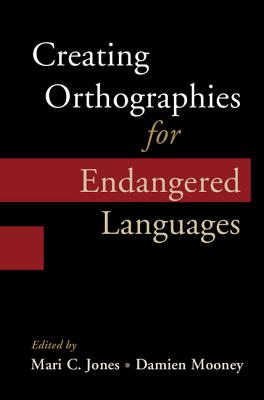
Creating Orthographies for Endangered Languages
Book Details
Format
Hardback
ISBN-10
1107148359
ISBN-13
9781107148352
Publisher
Cambridge University Press
Imprint
Cambridge University Press
Country of Manufacture
GB
Country of Publication
GB
Publication Date
Aug 31st, 2017
Print length
344 Pages
Weight
650 grams
Dimensions
23.50 x 16.00 x 2.30 cms
Product Classification:
Writing systems, alphabetsWriting systems, alphabets, scripts
KSh 14,750.00
Currently unavailable
0 in stock
Delivery Location
Delivery fee: Select location
Secure
Quality
Fast
This volume discusses how orthographies are being developed and implemented in the specific context of language endangerment and revitalisation. Chapters are written by academics working in the field of language endangerment and also by members of indigenous communities working 'at the coalface' of language support and maintenance.
Creating an orthography is often seen as a key component of language revitalisation. Encoding an endangered variety can enhance its status and prestige. In speech communities that are fragmented dialectally or geographically, a common writing system may help create a sense of unified identity, or help keep a language alive by facilitating teaching and learning. Despite clear advantages, creating an orthography for an endangered language can also bring challenges, and this volume debates the following critical questions: whose task should this be - that of the linguist or the speech community? Should an orthography be maximally distanciated from that of the language of wider communication for ideological reasons, or should its main principles coincide for reasons of learnability? Which local variety should be selected as the basis of a common script? Is a multilectal script preferable to a standardised orthography? And can creating an orthography create problems for existing native speakers?
Get Creating Orthographies for Endangered Languages by Damien Mooney at the best price and quality guaranteed only at Werezi Africa's largest book ecommerce store. The book was published by Cambridge University Press and it has 344 pages.
Customers Who Bought This Also Bought

The Little Book of Runes
KSh 1,600.00
Entstehung von Sprachen und Völkern
KSh 27,550.00

Interpunktion im Korpus
KSh 19,250.00

On the Mark
KSh 3,950.00

History of Writing
KSh 5,400.00
Symmetrie Bei Schriftsystemen
KSh 24,050.00
Die Schnittstelle von Morphologie und geschriebener Sprache
KSh 22,850.00
A Harmony of the Spirits
KSh 4,850.00

The Mesopotamian Riddle
KSh 2,000.00

A Sabda Reader
KSh 6,300.00
Phonics for Reading Level 1
KSh 2,150.00

Runes
KSh 3,400.00
