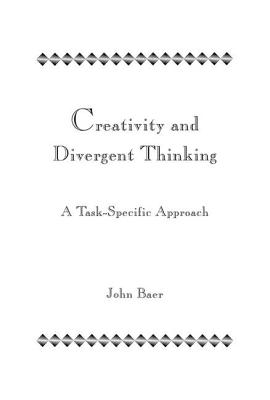
Creativity and Divergent Thinking : A Task-Specific Approach
by
John Baer
Book Details
Format
Paperback / softback
ISBN-10
1138966932
ISBN-13
9781138966932
Publisher
Taylor & Francis Ltd
Imprint
Psychology Press Ltd
Country of Manufacture
GB
Country of Publication
GB
Publication Date
Feb 29th, 2016
Print length
136 Pages
Weight
214 grams
Dimensions
15.40 x 22.90 x 1.20 cms
KSh 9,900.00
Currently unavailable
0 in stock
Delivery Location
Delivery fee: Select location
Secure
Quality
Fast
Do general-purpose creative-thinking skills -- skills like divergent thinking, which is touted as an important component of creative thinking no matter what the task domain -- actually make much of a contribution to creative performance? Although much recent research argues against such domain-transcending skills -- including several new studies reported in this book -- the appeal of such general skills remains strong, probably because of the theoretical economy and power such skills would provide. Divergent thinking, in particular, has had an incredible staying power. Despite its many flaws, divergent thinking remains the most frequently used indicator of creativity in both creativity research and educational practice, and divergent thinking theory has a strong hold on everyday conceptions of what it means to be creative.
Reviewing the available research on divergent thinking, this book presents a framework for understanding other major theories of creativity, including Mednick''s associative theory and a possible connectionist approach of creativity. It reports a series of studies (including the study that won APA''s 1992 Berlyne Prize) that demonstrate the absence of effects of general creative-thinking skills across a range of creativity-relevant tasks, but indicate that training in divergent thinking does in fact improve creative performance across diverse task domains. The book then ties these findings together with a multi-level theory, in which a task-specific approach to creativity is strengthened by recasting some divergent-thinking concepts into domain- and task-specific forms.
This book fills the gap between divergent-thinking theory and more recent, modular conceptions of creativity. Rather than advocate that we simply discard divergent thinking -- an approach that hasn''t worked, or at least hasn''t happened, because of many attacks on its validity and usefulness -- this book shows how to separate what is useful in divergent-thinking theory and practice from what is not. It shows that divergent-thinking training can be valuable, although often not for the reasons trainers think it works. And it offers specific suggestions about the kinds of creativity research most needed today.
Reviewing the available research on divergent thinking, this book presents a framework for understanding other major theories of creativity, including Mednick''s associative theory and a possible connectionist approach of creativity. It reports a series of studies (including the study that won APA''s 1992 Berlyne Prize) that demonstrate the absence of effects of general creative-thinking skills across a range of creativity-relevant tasks, but indicate that training in divergent thinking does in fact improve creative performance across diverse task domains. The book then ties these findings together with a multi-level theory, in which a task-specific approach to creativity is strengthened by recasting some divergent-thinking concepts into domain- and task-specific forms.
This book fills the gap between divergent-thinking theory and more recent, modular conceptions of creativity. Rather than advocate that we simply discard divergent thinking -- an approach that hasn''t worked, or at least hasn''t happened, because of many attacks on its validity and usefulness -- this book shows how to separate what is useful in divergent-thinking theory and practice from what is not. It shows that divergent-thinking training can be valuable, although often not for the reasons trainers think it works. And it offers specific suggestions about the kinds of creativity research most needed today.
Get Creativity and Divergent Thinking by John Baer at the best price and quality guaranteed only at Werezi Africa's largest book ecommerce store. The book was published by Taylor & Francis Ltd and it has 136 pages.
Customers Who Bought This Also Bought

Silent Patient
KSh 2,000.00

Ecce Homo
KSh 1,800.00

Wealth Money Can''t Buy
KSh 2,000.00

Man for Himself
KSh 3,350.00

Art of Manifesting PLC
KSh 2,350.00

Art of Manifesting
KSh 1,800.00
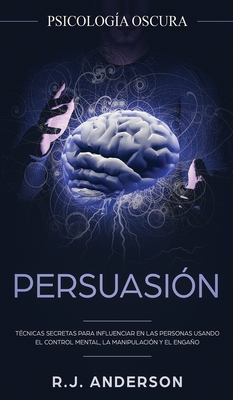
Persuasion
KSh 3,500.00

Philosophy of Psychology: Contemporary Readings
KSh 8,550.00

The Philosophy of Psychology
KSh 261,500.00
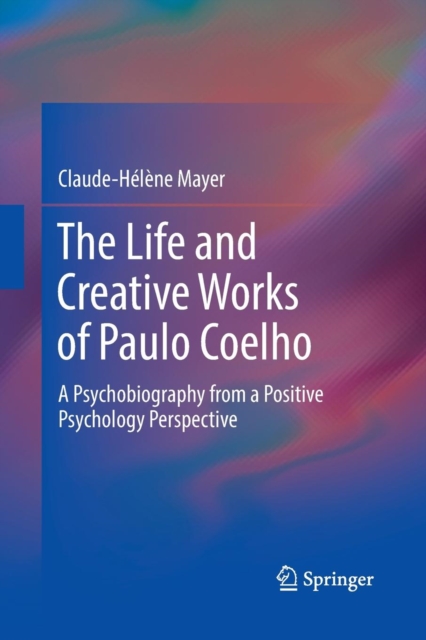
The Life and Creative Works of Paulo Coelho
KSh 21,600.00
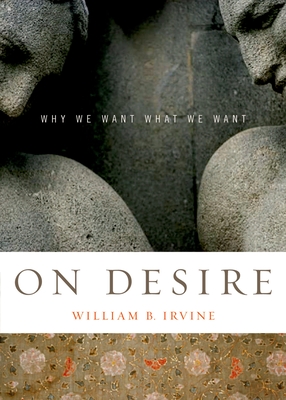
On Desire
KSh 3,050.00

On Interpretation
KSh 6,200.00