
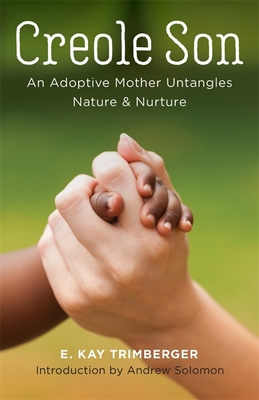
Creole Son : An Adoptive Mother Untangles Nature and Nurture
Book Details
Format
Paperback / softback
ISBN-10
080717310X
ISBN-13
9780807173107
Publisher
Louisiana State University Press
Imprint
Louisiana State University Press
Country of Manufacture
US
Country of Publication
GB
Publication Date
Apr 1st, 2020
Print length
212 Pages
Weight
288 grams
Dimensions
14.00 x 21.50 x 1.70 cms
KSh 5,400.00
Werezi Extended Catalogue
Delivery in 12 days
2 copies in stock
Delivery Location
Delivery fee: Select location
Delivery in 12 days
Secure
Quality
Fast
The compelling memoir of a single white mother searching to understand why her adopted biracial son grew from a happy child into a troubled young adult who struggled with addiction for decades. The answers, E. Kay Trimberger finds, lie in both nature and nurture.
Creole Son is the compelling memoir of a single white mother searching to understand why her
adopted biracial son grew from a happy child into a troubled young adult who struggled with addiction for decades. The answers, E. Kay Trimberger finds, lie in both nature and nurture.
When five-Âday-Âold Marco is flown from Louisiana to California and placed in Trimberger's arms, she assumes her values and example will be the determining influences upon her new son's life. Twenty-Âsix years later, when she helps him make contact with his Cajun and Creole biological relatives, she discovers that many of his cognitive and psychological strengths and difficulties mirror theirs. Using her training as a sociologist, Trimberger explores behavioral genetics research on adoptive families. To her relief as well as distress, she learns that both biological heritage and the environment- and their interaction- shape adult outcomes.
Trimberger shares deeply personal reflections about raising Marco in Berkeley in the 1980s and 1990s, with its easy access to drugs and a culture that condoned their use. She examines her own ignorance about substance abuse, and also a failed experiment in an alternative family lifestyle. In an afterword, Marc Trimberger contributes his perspective, noting a better understanding of his life journey gained through his mother's research.
By telling her story, Trimberger provides knowledge and support to all parents- biological and adoptive- with troubled offspring. She ends by suggesting a new adoption model, one that creates an extended, integrated family of both biological and adoptive kin.
adopted biracial son grew from a happy child into a troubled young adult who struggled with addiction for decades. The answers, E. Kay Trimberger finds, lie in both nature and nurture.
When five-Âday-Âold Marco is flown from Louisiana to California and placed in Trimberger's arms, she assumes her values and example will be the determining influences upon her new son's life. Twenty-Âsix years later, when she helps him make contact with his Cajun and Creole biological relatives, she discovers that many of his cognitive and psychological strengths and difficulties mirror theirs. Using her training as a sociologist, Trimberger explores behavioral genetics research on adoptive families. To her relief as well as distress, she learns that both biological heritage and the environment- and their interaction- shape adult outcomes.
Trimberger shares deeply personal reflections about raising Marco in Berkeley in the 1980s and 1990s, with its easy access to drugs and a culture that condoned their use. She examines her own ignorance about substance abuse, and also a failed experiment in an alternative family lifestyle. In an afterword, Marc Trimberger contributes his perspective, noting a better understanding of his life journey gained through his mother's research.
By telling her story, Trimberger provides knowledge and support to all parents- biological and adoptive- with troubled offspring. She ends by suggesting a new adoption model, one that creates an extended, integrated family of both biological and adoptive kin.
Get Creole Son by E. Kay Trimberger at the best price and quality guaranteed only at Werezi Africa's largest book ecommerce store. The book was published by Louisiana State University Press and it has 212 pages.
Customers Who Bought This Also Bought
Mother Mary Comes to Me
KSh 3,600.00

Youth
KSh 2,700.00

One Day, Everyone Will Have Always Been Against This
KSh 3,050.00

Mother Mary Comes To Me
KSh 2,350.00
Dreams in a Time of War
KSh 3,050.00

Hope
KSh 4,500.00

Mamba Mentality
KSh 6,400.00

More
KSh 3,050.00

Notes to John
KSh 2,700.00
Notes on Grief
KSh 1,450.00

Reading Lolita in Tehran
KSh 2,000.00
Childhood, Youth, Dependency
KSh 2,350.00
