
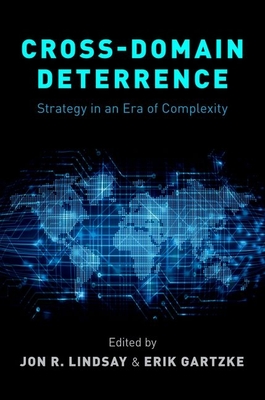
Cross-Domain Deterrence : Strategy in an Era of Complexity
Book Details
Format
Paperback / softback
ISBN-10
0190908653
ISBN-13
9780190908652
Publisher
Oxford University Press Inc
Imprint
Oxford University Press Inc
Country of Manufacture
GB
Country of Publication
GB
Publication Date
Mar 21st, 2019
Print length
408 Pages
Weight
638 grams
Dimensions
23.40 x 15.50 x 2.70 cms
Product Classification:
International relationsPolitical control & freedomsPeacekeeping operationsNuclear issues
KSh 10,950.00
Temporarily out of stock, due soon
0 in stock
Delivery Location
Delivery fee: Select location
Secure
Quality
Fast
Deterrence theory, which emerged during the Cold War, explains how states can use nuclear threats to prevent nuclear war. Today, however, the threat landscape is significantly more complex. Alongside ever-more sophisticated nuclear weapons arsenals, contemporary threats include cyberwarfare, anti-satellite weapons, robotic drones, and advanced conventional weapons. To deal with the new threat environment, the Pentagon identified five operational domains: land, sea, air, space, and cyberspace. The resulting model is an integrated, flexible regime that is able to deter threats across domains. In this volume, a leading cast of scholars and national security practitioners explore the logic and application of cross-domain deterrence in theory and practice.
The complexity of the twenty-first century threat landscape contrasts markedly with the bilateral nuclear bargaining context envisioned by classical deterrence theory. Nuclear and conventional arsenals continue to develop alongside anti-satellite programs, autonomous robotics or drones, cyber operations, biotechnology, and other innovations barely imagined in the early nuclear age. The concept of cross-domain deterrence (CDD) emerged near the end of the George W. Bush administration as policymakers and commanders confronted emerging threats to vital military systems in space and cyberspace. The Pentagon now recognizes five operational environments or so-called domains (land, sea, air, space, and cyberspace), and CDD poses serious problems in practice. In Cross-Domain Deterrence, Erik Gartzke and Jon R. Lindsay assess the theoretical relevance of CDD for the field of International Relations. As a general concept, CDD posits that how actors choose to deter affects the quality of the deterrence they achieve. Contributors to this volume include senior and junior scholars and national security practitioners. Their chapters probe the analytical utility of CDD by examining how differences across, and combinations of, different military and non-military instruments can affect choices and outcomes in coercive policy in historical and contemporary cases.
Get Cross-Domain Deterrence by Erik Gartzke at the best price and quality guaranteed only at Werezi Africa's largest book ecommerce store. The book was published by Oxford University Press Inc and it has 408 pages.
Customers Who Bought This Also Bought

Black Wave
KSh 2,700.00

Siege
KSh 2,000.00

Extractive Capitalism
KSh 2,150.00

Strategy
KSh 4,350.00

Fourth Industrial Revolution
KSh 2,700.00

On China
KSh 3,400.00

Dead Aid
KSh 3,400.00

The Bottom Billion
KSh 2,500.00

Leadership
KSh 2,700.00

How to Win a Trade War
KSh 3,050.00

Understanding Global Conflict and Cooperation: An Introduction to Theory and History
KSh 14,000.00

Nuclear Age
KSh 5,400.00
