
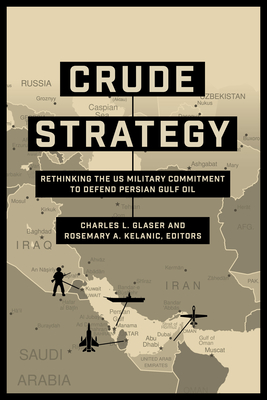
Crude Strategy : Rethinking the US Military Commitment to Defend Persian Gulf Oil
Book Details
Format
Paperback / softback
ISBN-10
1626163359
ISBN-13
9781626163355
Publisher
Georgetown University Press
Imprint
Georgetown University Press
Country of Manufacture
GB
Country of Publication
GB
Publication Date
Aug 12th, 2016
Print length
312 Pages
Weight
426 grams
Dimensions
15.50 x 22.90 x 1.90 cms
KSh 5,300.00
Currently unavailable
0 in stock
Delivery Location
Delivery fee: Select location
Secure
Quality
Fast
Policymakers and scholars have long assumed the US must maintain a military presence in the Middle East to protect access to Persian Gulf oil. The authors reconsider this policy based on analyses from a multidisciplinary team of political scientists, historians, and economists.
The United States has long-defined the free flow of Persian Gulf oil as a key component of its grand strategy. Since the late 1970s, U.S. military force has increasingly become the instrument for achieving this end. The American objective of ensuring the flow of Persian Gulf oil, by force if necessary, has rarely been questioned by scholars or policymakers since the Gulf became the site of U.S. military deployments. It is time to reexamine the U.S. military commitment to keeping Gulf oil flowing. Quite dramatic changes have occurred in world oil markets, the regional balance of power, and the limits of US defense budgets. This opens up the possibility that the United States should significantly revise its policy toward the Persian Gulf--both in terms of how it defines its strategic interests in the region, and the means it uses to pursue them. This volume brings together scholars of international relations and US foreign policy to examine the history and effects of the US presence in the Gulf and to weigh the costs and benefits of either keeping US forces in the region or pulling back.
Get Crude Strategy by Charles L. Glaser at the best price and quality guaranteed only at Werezi Africa's largest book ecommerce store. The book was published by Georgetown University Press and it has 312 pages.
Customers Who Bought This Also Bought

Black Wave
KSh 2,700.00

Siege
KSh 2,000.00

Extractive Capitalism
KSh 2,150.00

Strategy
KSh 4,350.00

Fourth Industrial Revolution
KSh 2,700.00

On China
KSh 3,400.00

Dead Aid
KSh 3,400.00

The Bottom Billion
KSh 2,500.00

Leadership
KSh 2,700.00
How to Win a Trade War
KSh 3,050.00

Understanding Global Conflict and Cooperation: An Introduction to Theory and History
KSh 14,000.00

Nuclear Age
KSh 5,400.00
