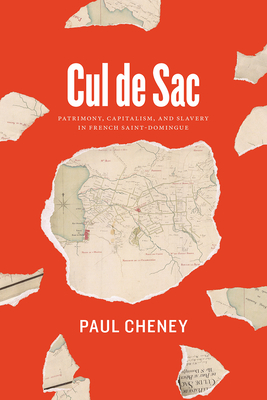
Cul de Sac : Patrimony, Capitalism, and Slavery in French Saint-Domingue
by
Paul Cheney
Book Details
Format
Hardback
ISBN-10
022607935X
ISBN-13
9780226079356
Publisher
The University of Chicago Press
Imprint
University of Chicago Press
Country of Manufacture
US
Country of Publication
GB
Publication Date
Feb 27th, 2017
Print length
264 Pages
Weight
510 grams
Dimensions
2.40 x 1.60 x 0.20 cms
Product Classification:
History
KSh 6,550.00
Currently unavailable
0 in stock
Delivery Location
Delivery fee: Select location
Secure
Quality
Fast
In the eighteenth century, the Cul de Sac plain in Saint-Domingue, now Haiti, was a vast open-air workhouse of sugar plantations. This microhistory of one plantation owned by the Ferron de la Ferronnayses, a family of Breton nobles, draws on remarkable archival finds to show that despite the wealth such plantations produced, they operated in a context of social, political, and environmental fragility that left them weak and crisis prone. Focusing on correspondence between the Ferronnayses and their plantation managers, Cul de Sac proposes that the Caribbean plantation system, with its reliance on factory-like production processes and highly integrated markets, was a particularly modern expression of eighteenth-century capitalism. But it rested on a foundation of economic and political traditionalism that stymied growth and adaptation. The result was a system heading toward collapse as planters, facing a series of larger crises in the French empire, vainly attempted to rein in the inherent violence and instability of the slave society they had built. In recovering the lost world of the French Antillean plantation, Cul de Sac ultimately reveals how the capitalism of the plantation complex persisted not as a dynamic source of progress, but from the inertia of a degenerate system headed down an economic and ideological dead end.
Get Cul de Sac by Paul Cheney at the best price and quality guaranteed only at Werezi Africa's largest book ecommerce store. The book was published by The University of Chicago Press and it has 264 pages.
Customers Who Bought This Also Bought
Born in Blackness – Africa, Africans, and the Making of the Modern World, 1471 to the Second World War
KSh 2,950.00

Migrations
KSh 5,450.00

The Lost City of Z
KSh 2,000.00

On War
KSh 1,200.00

The Lumumba Plot
KSh 3,050.00

Boer War
KSh 3,400.00

The Lessons of History
KSh 1,800.00

White Nights and Other Stories
KSh 3,900.00
A New World Begins
KSh 3,950.00

Reformation
KSh 3,400.00

Hiroshima Men
KSh 4,500.00

Genius Myth
KSh 3,050.00