
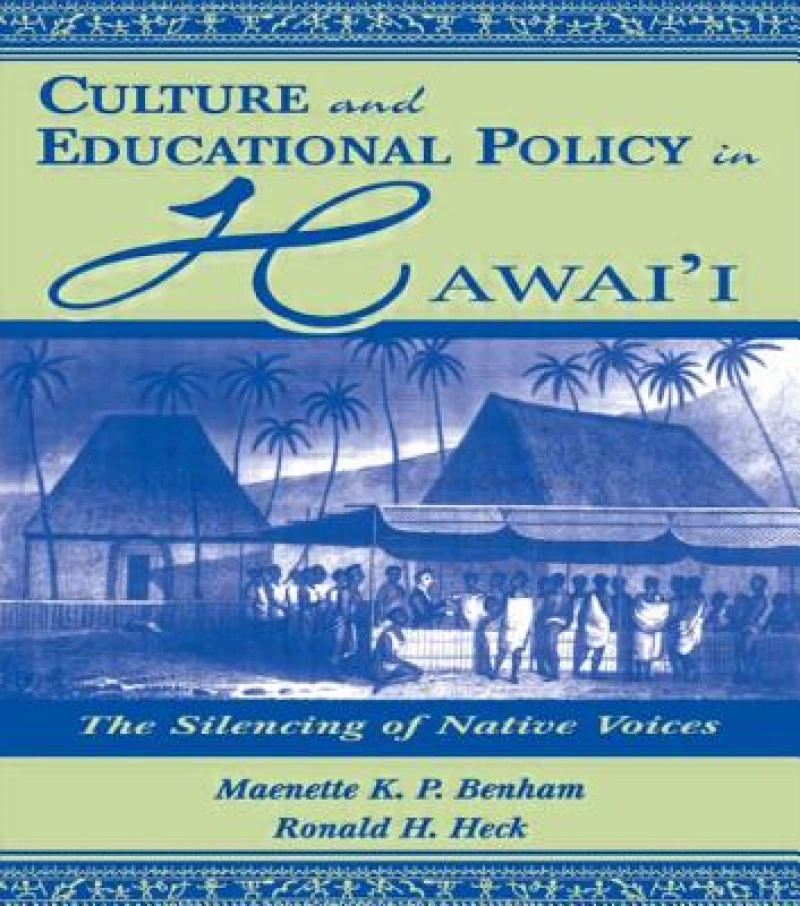
Culture and Educational Policy in Hawai'i : The Silencing of Native Voices
Book Details
Format
Paperback / Softback
ISBN-10
0805827048
ISBN-13
9780805827040
Publisher
Taylor & Francis Inc
Imprint
Routledge
Country of Manufacture
GB
Country of Publication
GB
Publication Date
Jun 1st, 1998
Print length
280 Pages
Weight
520 grams
Product Classification:
Cultural studiesOrganization & management of education
Ksh 11,200.00
Werezi Extended Catalogue
0 in stock
Delivery Location
Delivery fee: Select location
Secure
Quality
Fast
Provides a unified explanation of how dominant colonial educational practices have functioned over time to marginalize native peoples, in this case Hawaiians; focuses on evolution of culture and language policies in Hawaiian schools.
This comprehensive educational history of public schools in Hawai''i shows and analyzes how dominant cultural and educational policy have affected the education experiences of Native Hawaiians. Drawing on institutional theory as a scholarly lens, the authors focus on four historical cases representing over 150 years of contact with the West. They carefully link historical events, significant people, educational policy, and law to cultural and social consequences for Native Hawaiian children and youth.
The authors argue that since the early 1800s, educational policy in Hawai''i emphasizing efficiency has resulted in institutional structures that have degenerated Hawaiian culture, self-image, and sovereignty. Native Hawaiians have often been denied equal access to quality schools and resulting increased economic and social status. These policies were often overtly, or covertly, racist and reflected wider cultural views prevalent across the United States regarding the assimilation of groups into the American mainstream culture.
The case of education in Hawai''i is used to initiate a broader discussion of similar historical trends in assimilating children of different backgrounds into the American system of education. The scholarly analysis presented in this book draws out historical, political, cultural, and organizational implications that can be employed to understand other Native and non-Native contexts. Given the increasing cultural diversity of the United States and the perceived failure of the American educational system in light of these changes, this book provides an exceptionally appropriate starting point to begin a discussion about past, present, and future schooling for our nation''s children. Because it is written and comes from a Native perspective, the value of the "insider" view is illuminated. This underlying reminder of the Native eye is woven throughout the book in Ha''awina No''ono''o--the sharing of thoughts from the Native Hawaiian author.
With its primary focus on the education of native groups, this book is an extraordinary and useful work for scholars, thoughtful practitioners, policymakers, and those interested in Hawai''i, Hawaiian education, and educational policy and theory.
The authors argue that since the early 1800s, educational policy in Hawai''i emphasizing efficiency has resulted in institutional structures that have degenerated Hawaiian culture, self-image, and sovereignty. Native Hawaiians have often been denied equal access to quality schools and resulting increased economic and social status. These policies were often overtly, or covertly, racist and reflected wider cultural views prevalent across the United States regarding the assimilation of groups into the American mainstream culture.
The case of education in Hawai''i is used to initiate a broader discussion of similar historical trends in assimilating children of different backgrounds into the American system of education. The scholarly analysis presented in this book draws out historical, political, cultural, and organizational implications that can be employed to understand other Native and non-Native contexts. Given the increasing cultural diversity of the United States and the perceived failure of the American educational system in light of these changes, this book provides an exceptionally appropriate starting point to begin a discussion about past, present, and future schooling for our nation''s children. Because it is written and comes from a Native perspective, the value of the "insider" view is illuminated. This underlying reminder of the Native eye is woven throughout the book in Ha''awina No''ono''o--the sharing of thoughts from the Native Hawaiian author.
With its primary focus on the education of native groups, this book is an extraordinary and useful work for scholars, thoughtful practitioners, policymakers, and those interested in Hawai''i, Hawaiian education, and educational policy and theory.
Get Culture and Educational Policy in Hawai'i by at the best price and quality guaranteed only at Werezi Africa's largest book ecommerce store. The book was published by Taylor & Francis Inc and it has pages.

