
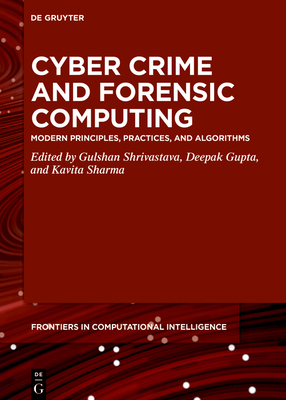
Cyber Crime and Forensic Computing : Modern Principles, Practices, and Algorithms
Book Details
Delivery Location
Delivery fee: Select location
This book presents a comprehensive study of different tools and techniques available to perform network forensics. Also, various aspects of network forensics are reviewed as well as related technologies and their limitations. This helps security practitioners and researchers in better understanding of the problem, current solution space, and future research scope to detect and investigate various network intrusions against such attacks efficiently.
Forensic computing is rapidly gaining importance since the amount of crime involving digital systems is steadily increasing. Furthermore, the area is still underdeveloped and poses many technical and legal challenges. The rapid development of the Internet over the past decade appeared to have facilitated an increase in the incidents of online attacks. There are many reasons which are motivating the attackers to be fearless in carrying out the attacks. For example, the speed with which an attack can be carried out, the anonymity provided by the medium, nature of medium where digital information is stolen without actually removing it, increased availability of potential victims and the global impact of the attacks are some of the aspects. Forensic analysis is performed at two different levels: Computer Forensics and Network Forensics. Computer forensics deals with the collection and analysis of data from computer systems, networks, communication streams and storage media in a manner admissible in a court of law. Network forensics deals with the capture, recording or analysis of network events in order to discover evidential information about the source of security attacks in a court of law.
Network forensics is not another term for network security. It is an extended phase of network security as the data for forensic analysis are collected from security products like firewalls and intrusion detection systems. The results of this data analysis are utilized for investigating the attacks. Network forensics generally refers to the collection and analysis of network data such as network traffic, firewall logs, IDS logs, etc. Technically, it is a member of the already-existing and expanding the field of digital forensics. Analogously, network forensics is defined as "The use of scientifically proved techniques to collect, fuses, identifies, examine, correlate, analyze, and document digital evidence from multiple, actively processing and transmitting digital sources for the purpose of uncovering facts related to the planned intent, or measured success of unauthorized activities meant to disrupt, corrupt, and or compromise system components as well as providing information to assist in response to or recovery from these activities." Network forensics plays a significant role in the security of todays organizations.
On the one hand, it helps to learn the details of external attacks ensuring similar future attacks are thwarted. Additionally, network forensics is essential for investigating insiders abuses that constitute the second costliest type of attack within organizations. Finally, law enforcement requires network forensics for crimes in which a computer or digital system is either being the target of a crime or being used as a tool in carrying a crime.
Network security protects the system against attack while network forensics focuses on recording evidence of the attack. Network security products are generalized and look for possible harmful behaviors. This monitoring is a continuous process and is performed all through the day. However, network forensics involves post mortem investigation of the attack and is initiated after crime notification. There are many tools which assist in capturing data transferred over the networks so that an attack or the malicious intent of the intrusions may be investigated. Similarly, various network forensic frameworks are proposed in the literature.
Get Cyber Crime and Forensic Computing by Deepak Gupta at the best price and quality guaranteed only at Werezi Africa's largest book ecommerce store. The book was published by De Gruyter and it has 240 pages.
Customers Who Bought This Also Bought

Yahoo Boys
KSh 3,950.00

Framed
KSh 2,000.00

Jeremy Hutchinson''s Case Histories
KSh 2,500.00

The Cambridge Handbook of Compliance
KSh 9,550.00

Confessions in the Courtroom
KSh 16,750.00

Confessions in the Courtroom
KSh 26,450.00

Cognitive Psychology for Forensic Experts
KSh 10,250.00

306-323
KSh 42,400.00

Procedural Justice?
KSh 13,150.00

The Spectacle
KSh 13,500.00

The Political Heart of Criminal Procedure
KSh 6,100.00

Scottish Criminal Law Essentials
KSh 16,200.00
