
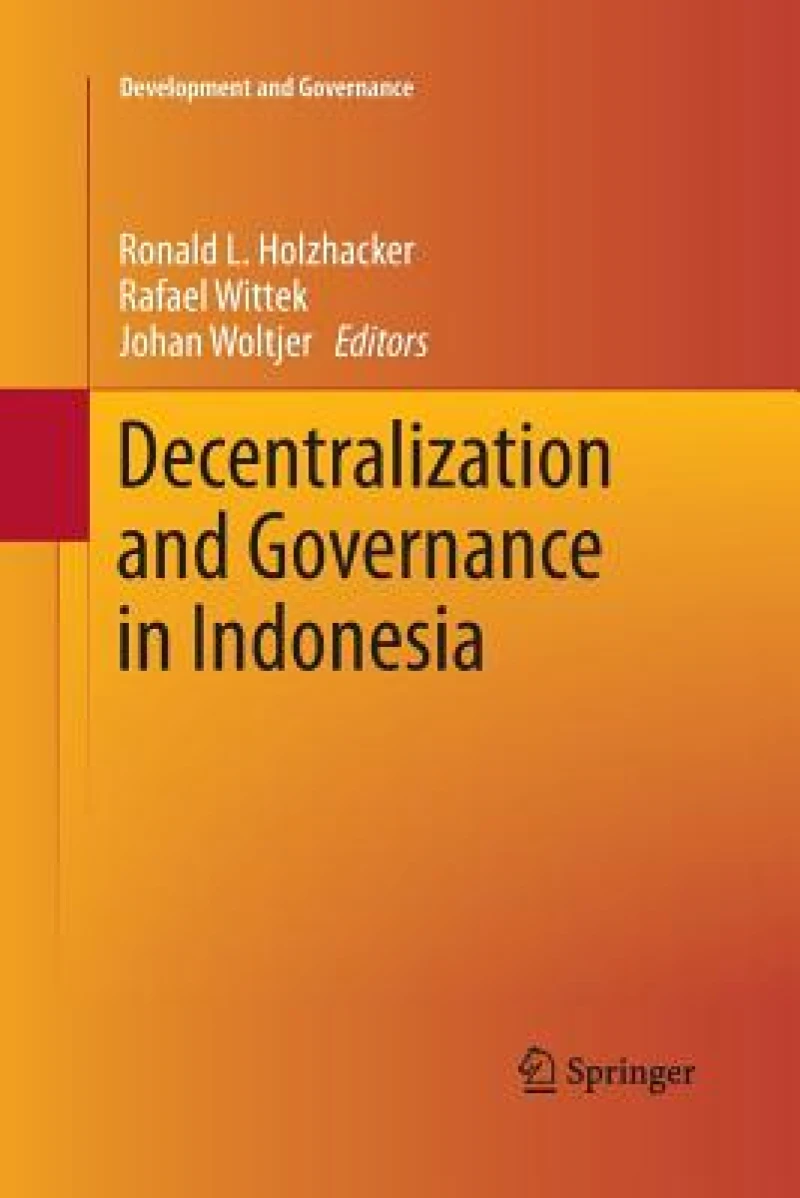
Decentralization and Governance in Indonesia
Softcover reprint of the original 1st ed. 2016
Book Details
Format
Paperback / Softback
Book Series
Development and Governance
ISBN-10
3319369954
ISBN-13
9783319369952
Edition
Softcover reprint of the original 1st ed. 2016
Publisher
Springer International Publishing AG
Imprint
Springer International Publishing AG
Country of Manufacture
CH
Country of Publication
GB
Publication Date
Aug 23rd, 2016
Print length
298 Pages
Ksh 16,200.00
Werezi Extended Catalogue
0 in stock
Delivery Location
Delivery fee: Select location
Secure
Quality
Fast
The book will also be of interest to business people interested in economic and governance issues, such as the management and governance of in-bound foreign investment, inclusive growth, and corporate governance.
Indonesia over the past two decades has embarked on a process of decentralization as part of a broader process of democratization, which followed earlier periods of centralized governance and authoritarian rule across the archipelago. The purpose of this book is to begin to explore the connections between governance and sustainable society in a wide variety of policy fields in Indonesia, and how reforming governance structures may contribute to societal benefits and the creation of a long-term sustainable society. This book bridges important theoretical debates related to governance and sustainable society and provides empirical research from Indonesia in important policy areas related to this debate. By placing research in different policy areas in a single volume, the link to the broader concepts of governance, decentralization, and societal outcomes is strengthened. The book builds on the recent interest that has focused on Indonesia and the continued development of democracy in the country. The chapters in the book show a rich variety of decentralized governance arrangements and capacity building at the local level in particular. Central standards (for example for social sustainability, anti-corruption arrangements, or for dealing with direct foreign investment), combined with local innovation (for example for municipal coordination of primary health care or metropolitan transport), are key to Indonesia as a country in a continuing process of transformation. We identify three key trends in the on-going process of decentralization and governance in Indonesia. First, we find that formal governance, the relation between the national and local government, is characterized by a system of ‘variable geometry multi-level governance’ depending on the policy area. The challenge ahead is strengthening accountability mechanisms to assure national standards while preserving and encouraging local innovation. Secondly, informal governance mechanisms are evolving to move from ‘hierarchical to network’ forms of governance. Here the challenge is to insure democratic input by citizens and civil society organizations. Finally, we identify a trend toward ‘shared value creation and sustainable cooperation.’ Indonesia is beginning to move from a rather singular policy focus on economic growth to a more complex and developing notion of policymaking for inclusive growth and the creation of a sustainable society for present and future generations. Here the challenge is sound implementation and to increase the effectiveness of governance mechanisms. There is also a noted diffusion of goals, to focus beyond the Jakarta metropolitan area to smaller regional cities, as urbanization continues and rural areas are changing. This book will be of interest for use in advanced undergraduate and graduate courses related to Southeast Asia in the fields of international relations, political science, public administration, economics, law, sociology, education, public health, and the spatial sciences. It will also be of interest to policymakers and government officials at the national and local level in Southeast Asia and middle-income developing countries, officials and policymakers in institutions of regional governance such as the Association of Southeast Asian Nations (ASEAN), and of global governance such as the United Nations and World Bank. It will also be of interest to civil society organizations and other actors focused on policy development and economic development, health, education, the environment, sustainable transport, etc. The book will also be of interest to business people interested in economic and governance issues, such as the management and governance of in-bound foreign investment, inclusive growth, and corporate governance. Finally, the book should be of interest to citizens in advanced, middle-income, and developing countries motivated to learn more about the links between governance and the creation of a sustainable society for current and future generations.
Get Decentralization and Governance in Indonesia by at the best price and quality guaranteed only at Werezi Africa's largest book ecommerce store. The book was published by Springer International Publishing AG and it has pages.

