
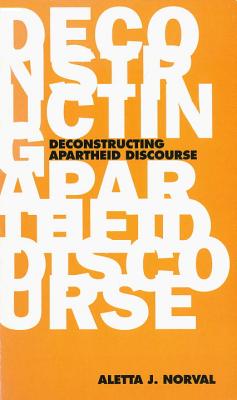
Deconstructing Apartheid Discourse
Book Details
Format
Paperback / softback
Book Series
Phronesis
ISBN-10
1859841252
ISBN-13
9781859841259
Publisher
Verso Books
Imprint
Verso Books
Country of Manufacture
GB
Country of Publication
GB
Publication Date
Apr 17th, 1996
Print length
400 Pages
Weight
466 grams
Dimensions
21.80 x 13.50 x 2.80 cms
KSh 5,000.00
Currently unavailable
0 in stock
Delivery Location
Delivery fee: Select location
Secure
Quality
Fast
This work questions the nature of the apartheid system and the identities it fostered. It includes an in-depth examination of the institution of apartheid as a new form of social division, and a combination of post-Marxist and post-structuralist theories of social division and identity formation.
With the demise of apartheid in South Africa and the movement towards a post-apartheid society in South Africa, questions concerning the nature of apartheid and the identities it fostered are inevitably raised. Deconstructing Apartheid Discourse addresses these issues by revealing both their historical specificity and their implications for the full development of a democratic post-apartheid order.
The analysis covers the institution of apartheid as a new form of social division, the transformationist project which characterized it during the 1970s and 1980s, and the disarticulation of that project from the mid 1980s to the present. Central to this analysis is the contention that apartheid, as a failed hegemonic project, can only be understood in its full complexity if attention is given to the specificity of the mode of social division it instituted. The book thus seeks to trace the construction and contestation of the central axes around which its political frontiers were organized.
Drawing on a combination of post-Marxist and post-structuralist theorizations of social division and identity formation, Norval develops an account of apartheid discourse which avoids the twin pitfalls of essentialism and objectivism. She offers an analysis of contending visions—including the discources of the far-right, Inkatha, the new National Party and the ANC—for the future of South Africa, and investigates the prospects for the elaboration of non-racialism as a new political imaginary.
The analysis covers the institution of apartheid as a new form of social division, the transformationist project which characterized it during the 1970s and 1980s, and the disarticulation of that project from the mid 1980s to the present. Central to this analysis is the contention that apartheid, as a failed hegemonic project, can only be understood in its full complexity if attention is given to the specificity of the mode of social division it instituted. The book thus seeks to trace the construction and contestation of the central axes around which its political frontiers were organized.
Drawing on a combination of post-Marxist and post-structuralist theorizations of social division and identity formation, Norval develops an account of apartheid discourse which avoids the twin pitfalls of essentialism and objectivism. She offers an analysis of contending visions—including the discources of the far-right, Inkatha, the new National Party and the ANC—for the future of South Africa, and investigates the prospects for the elaboration of non-racialism as a new political imaginary.
Get Deconstructing Apartheid Discourse by Aletta J Norval at the best price and quality guaranteed only at Werezi Africa's largest book ecommerce store. The book was published by Verso Books and it has 400 pages.
Customers Who Bought This Also Bought
Culture and Imperialism
KSh 2,700.00

Curfew
KSh 7,950.00

The Invention of Yesterday
KSh 5,400.00

Ruin of Kasch
KSh 2,350.00

Exercised
KSh 2,700.00

Structural Anthropology
KSh 3,950.00

The Botany of Desire
KSh 2,700.00

Sapiens A Graphic History, Volume 2
KSh 4,300.00

Sapiens A Graphic History, Volume 1
KSh 4,600.00

Game Without Frontiers
KSh 11,150.00

Rainforest Warriors
KSh 4,300.00

Causes and Consequences of Human Migration
KSh 18,200.00
