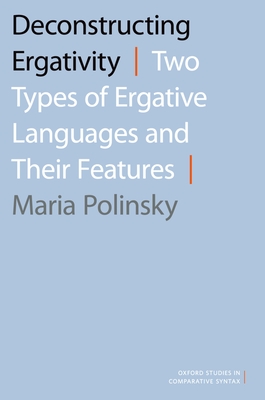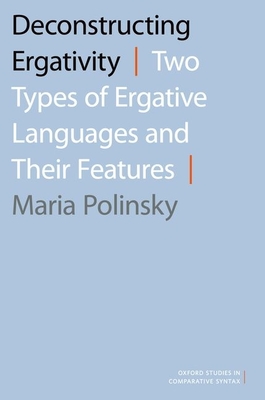
Deconstructing Ergativity : Two Types of Ergative Languages and Their Features
Book Details
Format
Hardback
Book Series
Oxford Studies in Comparative Syntax
ISBN-10
0190256583
ISBN-13
9780190256586
Publisher
Oxford University Press Inc
Imprint
Oxford University Press Inc
Country of Manufacture
US
Country of Publication
GB
Publication Date
May 12th, 2016
Print length
412 Pages
Weight
757 grams
Dimensions
16.00 x 23.90 x 2.50 cms
Product Classification:
Historical & comparative linguisticsGrammar, syntax & morphology
KSh 25,200.00
Temporarily out of stock, due soon
0 in stock
Delivery Location
Delivery fee: Select location
Secure
Quality
Fast
Building upon theoretical innovations and extensive empirical findings, this book explains variation in the syntactic behavior of ergative arguments across languages. It offers a new analysis of ergativity by recognizing two distinct types, PP-ergative- and DP-ergative-languages. Each type is characterized by a set of correlated features which result in structural consistency.
Nominative-accusative and ergative are two common alignment types found across languages. In the former type, the subject of an intransitive verb and the subject of a transitive verb are expressed the same way, and differently from the object of a transitive. In ergative languages, the subject of an intransitive and the object of a transitive appear in the same form, the absolutive, and the transitive subject has a special, ergative, form. Ergative languages often follow very different patterns, thus evading a uniform description and analysis. A simple explanation for that has to do with the idea that ergative languages, much as their nominative-accusative counterparts, do not form a uniform class. In this book, Maria Polinsky argues that ergative languages instantiate two main types, the one where the ergative subject is a prepositional phrase (PP-ergatives) and the one with a noun-phrase ergative. Each type is internally consistent and is characterized by a set of well-defined properties. The book begins with an analysis of syntactic ergativity, which as Polinsky argues, is a manifestation of the PP-ergative type. Polinsky discusses diagnostic properties that define PPs in general and then goes to show that a subset of ergative expressions fit the profile of PPs. Several alternative analyses have been proposed to account for syntactic ergativity; the book presents and outlines these analyses and offers further considerations in support of the PP-ergativity approach. The book then discusses the second type, DP-ergative languages, and traces the diachronic connection between the two types. The book includes two chapters illustrating paradigm PP-ergative and DP-ergative languages: Tongan and Tsez. The data used in these descriptions come from Polinsky''s original fieldwork hence presenting new empirical facts from both languages.
Get Deconstructing Ergativity by Maria Polinsky at the best price and quality guaranteed only at Werezi Africa's largest book ecommerce store. The book was published by Oxford University Press Inc and it has 412 pages.
Customers Who Bought This Also Bought

Adventure Of English
KSh 2,350.00

Naming of the Shrew
KSh 2,000.00
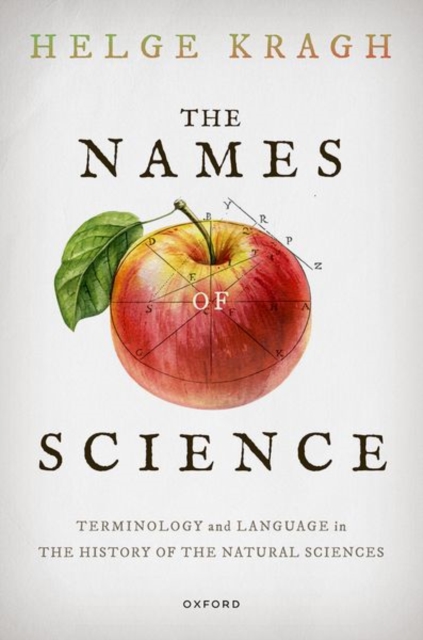
The Names of Science
KSh 7,850.00

A Grammar of Teotitlan del Valle Zapotec
KSh 28,100.00

Romania Africana
KSh 32,750.00
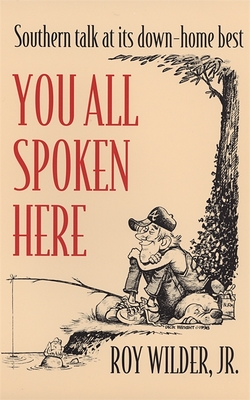
You All Spoken Here
KSh 4,950.00

A Comparative Analysis of Classifier-Noun Structures in Chinese and English
KSh 32,000.00
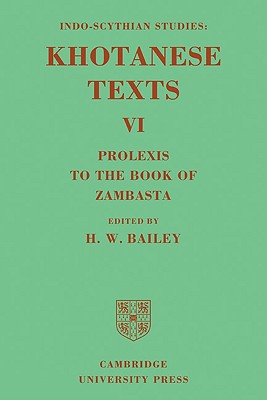
Indo-Scythian Studies, Volume VI
KSh 9,750.00

African Englishes and Multilingualism for the Transformative Development of Postcolonial Africa
KSh 6,100.00
Morphologische Untersuchungen Auf Dem Gebiete Der Indogermanischen Sprachen
KSh 7,200.00
Interactions across Englishes
KSh 18,700.00
Semantic Interpretation and the Resolution of Ambiguity
KSh 7,600.00