Cart 0
Deep Generative Modeling
Click to zoom

Share this book

Deep Generative Modeling

2022 ed.

Book Details

Format Paperback / Softback
ISBN-10 3030931609
ISBN-13 9783030931605
Edition 2022 ed.
Publisher Springer Nature Switzerland AG
Imprint Springer Nature Switzerland AG
Country of Manufacture GB
Country of Publication GB
Publication Date Feb 20th, 2023
Print length 197 Pages
Weight 340 grams
Dimensions 15.50 x 23.50 x 1.80 cms
Ksh 8,100.00
Temporarily out of stock, due soon 0 in stock

Delivery Location

Delivery fee: Select location

Secure
Quality
Fast
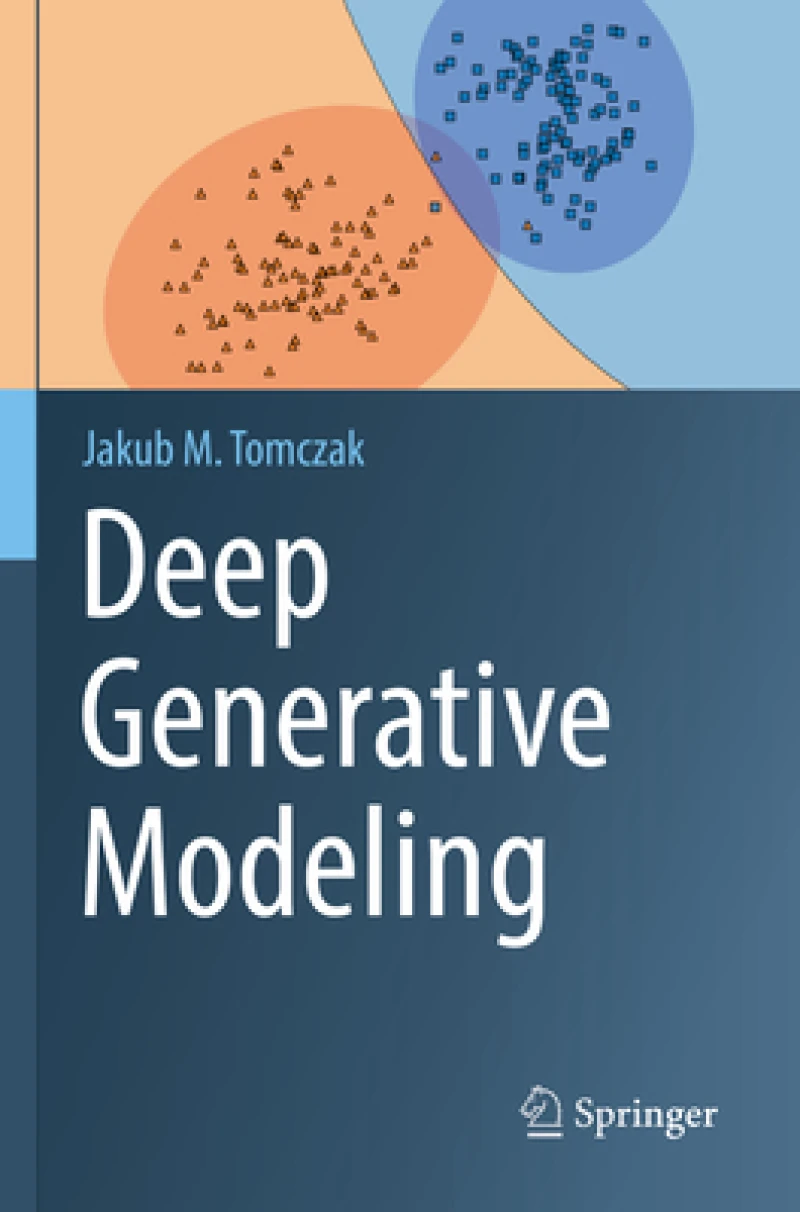
This textbook tackles the problem of formulating AI systems by combining probabilistic modeling and deep learning. Moreover, it goes beyond typical predictive modeling and brings together supervised learning and unsupervised learning. The resulting paradigm, called deep generative modeling, utilizes the generative perspective on perceiving the surrounding world. It assumes that each phenomenon is driven by an underlying generative process that defines a joint distribution over random variables and their stochastic interactions, i.e., how events occur and in what order. The adjective "deep" comes from the fact that the distribution is parameterized using deep neural networks. There are two distinct traits of deep generative modeling. First, the application of deep neural networks allows rich and flexible parameterization of distributions. Second, the principled manner of modeling stochastic dependencies using probability theory ensures rigorous formulation and prevents potential flaws in reasoning. Moreover, probability theory provides a unified framework where the likelihood function plays a crucial role in quantifying uncertainty and defining objective functions. Deep Generative Modeling is designed to appeal to curious students, engineers, and researchers with a modest mathematical background in undergraduate calculus, linear algebra, probability theory, and the basics in machine learning, deep learning, and programming in Python and PyTorch (or other deep learning libraries). It will appeal to students and researchers from a variety of backgrounds, including computer science, engineering, data science, physics, and bioinformatics, who wish to become familiar with deep generative modeling. To engage the reader, the book introduces fundamental concepts with specific examples and code snippets. The full code accompanying the book is available on github. The ultimate aim of the book is to outline the most important techniques in deep generative modeling and, eventually, enable readers to formulate new models and implement them.

This textbook tackles the problem of formulating AI systems by combining probabilistic modeling and deep learning. Moreover, it goes beyond typical predictive modeling and brings together supervised learning and unsupervised learning. The resulting paradigm, called deep generative modeling, utilizes the generative perspective on perceiving the surrounding world. It assumes that each phenomenon is driven by an underlying generative process that defines a joint distribution over random variables and their stochastic interactions, i.e., how events occur and in what order. The adjective "deep" comes from the fact that the distribution is parameterized using deep neural networks. There are two distinct traits of deep generative modeling. First, the application of deep neural networks allows rich and flexible parameterization of distributions. Second, the principled manner of modeling stochastic dependencies using probability theory ensures rigorous formulation and prevents potential flaws in reasoning. Moreover, probability theory provides a unified framework where the likelihood function plays a crucial role in quantifying uncertainty and defining objective functions.

Deep Generative Modeling is designed to appeal to curious students, engineers, and researchers with a modest mathematical background in undergraduate calculus, linear algebra, probability theory, and the basics in machine learning, deep learning, and programming in Python and PyTorch (or other deep learning libraries). It will appeal to students and researchers from a variety of backgrounds, including computer science, engineering, data science, physics, and bioinformatics, who wish to become familiar with deep generative modeling. To engage the reader, the book introduces fundamental concepts with specific examples and code snippets. The full code accompanying the book is available on github.

The ultimate aim of the book is to outline the most important techniques in deep generative modeling and, eventually, enable readers to formulate new models and implement them.


Get Deep Generative Modeling by at the best price and quality guaranteed only at Werezi Africa's largest book ecommerce store. The book was published by Springer Nature Switzerland AG and it has pages.


Mind, Body, & Spirit

Shopping Cart

Africa largest book store

Sub Total:
Ebooks

Digital Library
Coming Soon

Our digital collection is currently being curated to ensure the best possible reading experience on Werezi. We'll be launching our Ebooks platform shortly.