
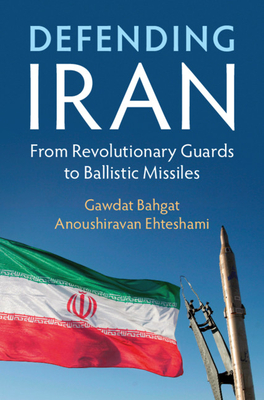
Defending Iran : From Revolutionary Guards to Ballistic Missiles
Book Details
Format
Hardback
ISBN-10
1108476783
ISBN-13
9781108476782
Publisher
Cambridge University Press
Imprint
Cambridge University Press
Country of Manufacture
GB
Country of Publication
GB
Publication Date
Sep 23rd, 2021
Print length
304 Pages
Weight
582 grams
Dimensions
16.10 x 23.60 x 2.30 cms
KSh 12,800.00
Currently unavailable
0 in stock
Delivery Location
Delivery fee: Select location
Secure
Quality
Fast
Offering a detailed and authoritative analysis of Iran's defense doctrine and security policies, this examines Iran's military capabilities and compares these with those of other regional powers, including Israel and Saudi Arabia for a broad analysis of security and political relations in the Middle East.
Since the 1979 revolution, the ruling establishment of Iran has developed and articulated a defense strategy reflective of the country''s Iran-Iraq war experience and its international isolation. Its asymmetrical warfare doctrine, use of irregular forces in military campaigns, deployment of ballistic missiles, use of fast naval vessels to harass and confuse adversaries, and finally development of a sophisticated cyber warfare capability, are all features of this unique defense strategy. Based on a wide range of primary sources in Persian, Arabic and English, Gawdat Bahgat and Anoushiravan Ehteshami offer a detailed and authoritative analysis of Iran''s defense strategy. Additionally, this book provides a comparative analysis of the Islamic Republic''s capabilities in relation to Israel and Saudi Arabia, its main regional adversaries. Framing Tehran''s threat perceptions following the revolution within a wider historical context, this book will facilitate further analytical reflections on the country''s changing role in the region, and its relations further afield, with the United States, Europe, Russia and China.
Get Defending Iran by Anoushiravan Ehteshami, Gawdat Bahgat at the best price and quality guaranteed only at Werezi Africa's largest book ecommerce store. The book was published by Cambridge University Press and it has 304 pages.
Customers Who Bought This Also Bought

History of the Arab Peoples
KSh 2,700.00

Black Wave
KSh 2,700.00

My Promised Land
KSh 3,400.00

The Hundred Years'' War on Palestine
KSh 2,150.00

The Ethnic Cleansing of Palestine
KSh 2,350.00

Letters to My Palestinian Neighbor
KSh 3,400.00
Question of Palestine
KSh 2,700.00

Palestine
KSh 2,400.00

King of Kings
KSh 4,500.00

Recognising the Stranger
KSh 1,800.00

The Idea of Israel
KSh 2,700.00

Israel on the Brink
KSh 2,350.00
More by Anoushiravan Ehteshami, Gawdat Bahgat

Iran and the Rise of Its Neoconservatives
KSh 9,900.00

The International Politics of the Red Sea
KSh 30,950.00

Syria and Iran
KSh 10,100.00

Islamic Fundamentalism
KSh 30,950.00

Islam, IS and the Fragmented State
KSh 26,300.00

The International Politics of the Red Sea
KSh 11,150.00
Iran
KSh 11,350.00

How China''s Rise is Changing the Middle East
KSh 30,950.00

Islamic Fundamentalism
KSh 10,450.00

Globalization and Geopolitics in the Middle East
KSh 30,950.00

Iran
KSh 33,850.00

Dynamics of Change in the Persian Gulf
KSh 30,950.00
