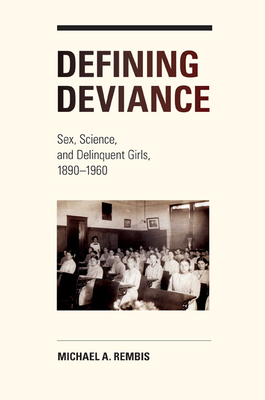
Defining Deviance : Sex, Science, and Delinquent Girls, 1890-1960
Book Details
Format
Paperback / softback
ISBN-10
0252079272
ISBN-13
9780252079276
Publisher
University of Illinois Press
Imprint
University of Illinois Press
Country of Manufacture
US
Country of Publication
GB
Publication Date
Feb 1st, 2013
Print length
248 Pages
Weight
376 grams
Dimensions
23.20 x 19.50 x 1.50 cms
KSh 5,050.00
Currently unavailable
0 in stock
Delivery Location
Delivery fee: Select location
Secure
Quality
Fast
Analyzes how reformers in the late nineteenth and early twentieth centuries perceived delinquent girls and their often troubled lives.
Defining Deviance analyzes how reformers in the late nineteenth and early twentieth centuries perceived delinquent girls and their often troubled lives. Drawing on exclusive access to thousands of case files and other documents at the State Training School in Geneva, Illinois, Michael A. Rembis uses Illinois as a case study to show how implementation of involuntary commitment laws in the United States reflected eugenic thinking about juvenile delinquency.
Much more than an institutional history, Defining Deviance examines the cases of vulnerable young women to reveal the centrality of sex, class, gender, and disability in the formation of scientific and social reform. Rembis recounts the contestations between largely working-class teenage girls and the mostly female reformers and professionals who attempted to diagnose and treat them based on changing ideas of eugenics, gender, and impairment. He shows how generational roles and prevailing notions of gender and sexuality influenced reformers to restrict, control, and institutionalize undesirable "defectives" within society, and he details the girls'' attempts to influence methods of diagnosis, discipline, and reform.
In tracing the historical evolution of ideologies of impairment and gender to show the central importance of gender to the construction of disability, Rembis reveals the larger national implications of the cases at the State Training School. His study provides new insights into the treatment of young women whom the dominant society perceived as threats to the sexual and eugenic purity of modern America.
Get Defining Deviance by Michael Rembis at the best price and quality guaranteed only at Werezi Africa's largest book ecommerce store. The book was published by University of Illinois Press and it has 248 pages.
Customers Who Bought This Also Bought

Crusade for Justice – The Autobiography of Ida B. Wells, Second Edition
KSh 4,050.00

Killers of the Flower Moon
KSh 2,000.00

Warmth of Other Suns
KSh 3,050.00

Frederick Douglass
KSh 3,350.00

107 Days
KSh 4,500.00

Second Treatise of Government – Norton Library
KSh 1,600.00

Tuesdays With Morrie
KSh 2,000.00

My Bondage and My Freedom
KSh 1,600.00

Hidden Figures
KSh 2,000.00

America, América
KSh 3,650.00

Holding the Line
KSh 2,000.00

Nuclear Folly
KSh 3,050.00