
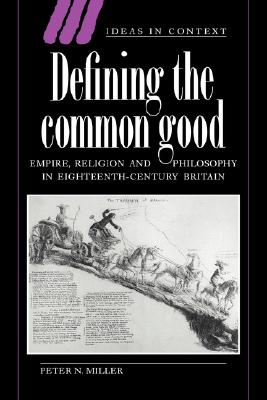
Defining the Common Good : Empire, Religion and Philosophy in Eighteenth-Century Britain
Book Details
Format
Hardback
Book Series
Ideas in Context
ISBN-10
0521442591
ISBN-13
9780521442596
Publisher
Cambridge University Press
Imprint
Cambridge University Press
Country of Manufacture
GB
Country of Publication
GB
Publication Date
Jun 16th, 1994
Print length
488 Pages
Weight
884 grams
Dimensions
16.00 x 23.70 x 3.70 cms
KSh 22,700.00
Currently unavailable
0 in stock
Delivery Location
Delivery fee: Select location
Secure
Quality
Fast
This book discusses the crisis of the early modern state in eighteenth-century Britain sparked off by the American revolution. It sets the crisis in its European context and traces the evolution of influential political ideas which continue to resonate today in the principles of 'one man, one vote' and 'freedom of thought'.
The theme of this book is the crisis of the early modern state in eighteenth-century Britain. The revolt of the North American colonies and the simultaneous demand for wider religious toleration at home challenged the principles of sovereignty and obligation that underpinned arguments about the character of the state. These were expressed in terms of the 'common good', 'necessity', and 'community' - concepts that came to the fore in early modern European political thought and which gave expression to the problem of defining legitimate authority in a period of increasing consciousness of state power. The Americans and their British supporters argued that individuals ought to determine the common good of the community. A new theory of representation and freedom of thought defines the cutting edge of this revolutionary redefinition of the basic relationship between individual and community.
Get Defining the Common Good by Peter N. Miller at the best price and quality guaranteed only at Werezi Africa's largest book ecommerce store. The book was published by Cambridge University Press and it has 488 pages.
Customers Who Bought This Also Bought

Churchill
KSh 3,700.00
Difficult Women
KSh 2,350.00

Legacy of Violence
KSh 3,150.00
Agricola and the Germania
KSh 2,350.00
Empireland
KSh 2,150.00

The History of the Kings of Britain
KSh 2,350.00

Siege
KSh 2,000.00

Anarchy
KSh 2,700.00
What Matters in Jane Austen?
KSh 2,700.00
Unruly
KSh 2,150.00
Map Of A Nation
KSh 2,350.00

Black and British
KSh 2,350.00
More by Peter N. Miller
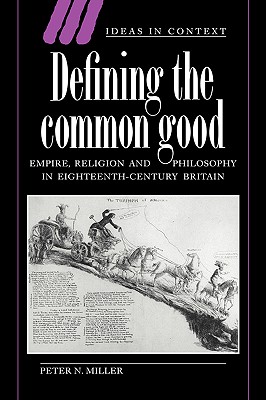
Defining the Common Good
KSh 7,400.00

Research
KSh 3,600.00

Richard Tuttle – What Is the Object?
KSh 18,800.00
Cultural Histories of the Material World
KSh 3,950.00
The Song of the Soul
KSh 30,950.00
The Museum in the Cultural Sciences – Collecting, Displaying, and Interpreting Material Culture in the Twentieth Century
KSh 9,650.00
Peiresc''s Orient
KSh 33,150.00
History and Its Objects
KSh 7,200.00
Dutch New York, between East and West
KSh 14,600.00
Peiresc''s Orient
KSh 9,250.00

On Conservation as a Human Science
KSh 5,050.00
Markets, Morals, Politics – Jealousy of Trade and the History of Political Thought
KSh 9,550.00
