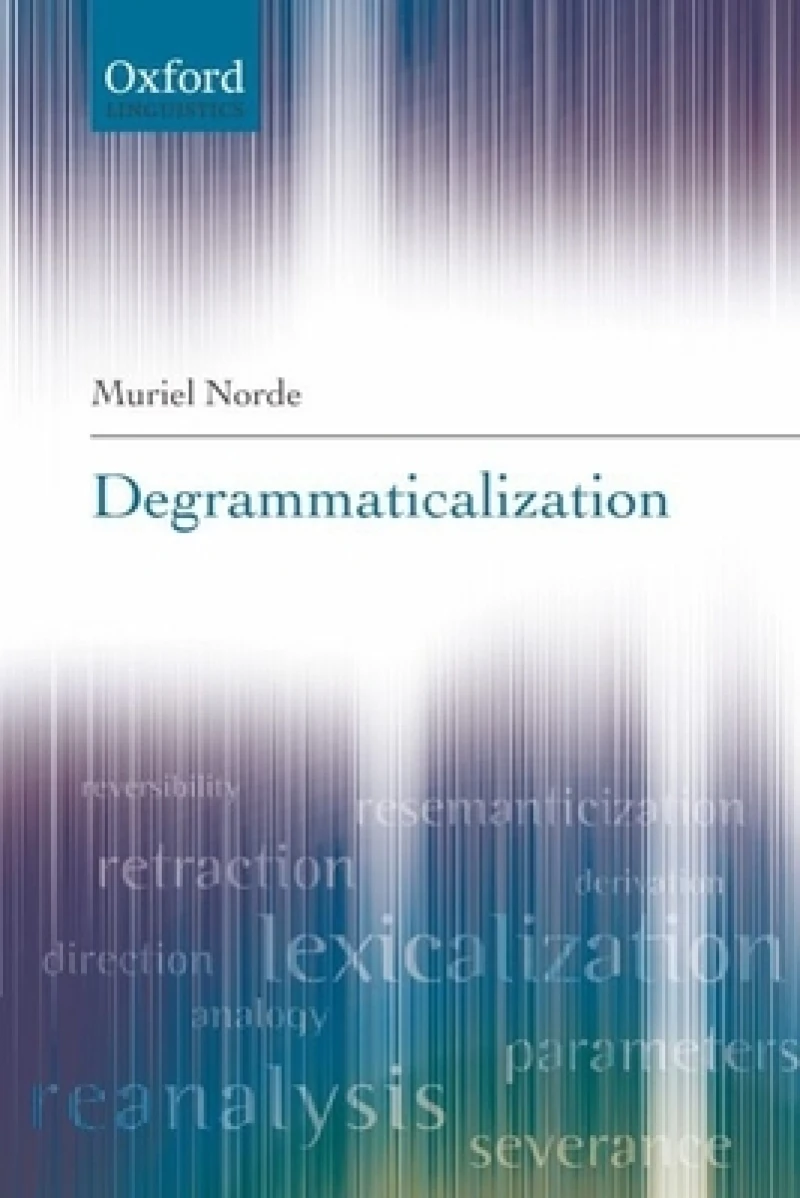
Degrammaticalization
by
Muriel Norde
Book Details
Format
Hardback or Cased Book
ISBN-10
0199207925
ISBN-13
9780199207923
Publisher
Oxford University Press
Imprint
Oxford University Press
Country of Manufacture
GB
Country of Publication
GB
Publication Date
Sep 17th, 2009
Print length
290 Pages
Weight
586 grams
Dimensions
24.10 x 16.20 x 2.10 cms
Ksh 22,050.00
Manufactured on Demand
0 in stock
Delivery Location
Delivery fee: Select location
Secure
Quality
Fast
Muriel Norde shows that linguistic change via the well-attested process of grammaticalization is reversible and that degrammaticalization can occur on all levels: semantic, morphological, syntactic, and phonological. Her careful analysis of the process makes a significant contribution to methods of linguistic reconstruction and language change.
Grammaticalization is a well-attested process of linguistic change in which a lexical item becomes a function word, which may be further reduced to a clitic or affix. Proponents of the universality of grammaticalization have usually argued that it is unidirectional and have thus found it a useful tool in linguistic reconstruction. In this book Prof Norde shows that change is reversible on all levels: semantic, morphological, syntactic, and phonological. As a consequence, the alleged unidirectionality of grammaticalization is not a reliable reconstructional tool, even if degrammaticalization is a rare phenomenon.Degrammaticalization, she argues, is essentially different from grammaticalization: it usually comprises a single change, examples being shifts from affix to clitic, or from function word to lexical item. And where grammaticalization can be seen as a process, degrammaticalization is often the by-product of other changes. Nevertheless, she shows that it can be described, like grammaticalization, in a principled way, in order to establish whether a change in a word has been from more to less grammatical or vice versa, and the stages by which it has become so. Using data from different languages she constructs a typology of degrammaticalization changes. She explains why degrammaticalization is so rare and why some linguists have such strongly negative feelings about the possibility of its existence. She adds to the understanding of grammaticalization and makes a significant contribution to methods of linguistic reconstruction and the study of language change. She writes clearly, aiming to be understood by advanced undergraduate students as well as appealing to scholars and graduate researchers in historical linguistics.
Get Degrammaticalization by at the best price and quality guaranteed only at Werezi Africa's largest book ecommerce store. The book was published by Oxford University Press and it has pages.