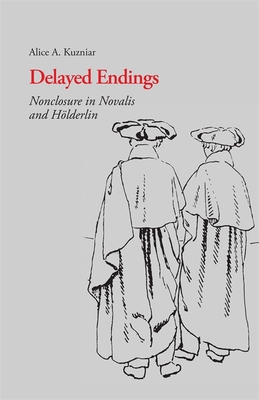
Delayed Endings : Nonclosure in Novalis and Holderlin
Book Details
Format
Paperback / softback
ISBN-10
0820332445
ISBN-13
9780820332444
Publisher
University of Georgia Press
Imprint
University of Georgia Press
Country of Manufacture
US
Country of Publication
GB
Publication Date
Apr 1st, 2008
Print length
264 Pages
Weight
454 grams
Dimensions
21.60 x 14.00 x 1.50 cms
Product Classification:
Literary studies: general
KSh 6,050.00
Currently unavailable
0 in stock
Delivery Location
Delivery fee: Select location
Secure
Quality
Fast
Kuzniar demonstrates how Novalis and Hölderlin exemplified the Romantics’ new way of narrating time, and how their method of nonclosure, or the deliberate avoidance of resolution and the strategies that bring it about, united the narrative, semantic, and thematic strains of their work.
The works of the German Romantic authors Novalis (Friedrich von Hardenberg) and Friedrich Hölderlin were profoundly affected by their loss of belief in endings and ultimacies. They wrote during an age of intellectual crisis, when apocalyptic expectations had reached their pitch and the volatile ideas generated by the French Revolution seemed to challenge even the passing of time itself. In Delayed Endings, Alice A. Kuzniar demonstrates how Novalis and Hölderlin exemplified the Romantics' new way of narrating time, and how their method of nonclosure, or the deliberate avoidance of resolution and the strategies that bring it about, united the narrative, semantic, and thematic strains of their work. Novalis's Heinrich von Ofterdingen not only lacks a conclusion but even has a ruptured and disoriented beginning. Sharing Novalis's obsession with deferred endings, Hölderlin's late verse fragments and revisions reflect his questioning of ultimate human endings. Just as the persona in his hymn "Patmos" is within close proximity of friends but forever separated from them by treacherous alpine gorges, so too is God near yet incomprehensible. Novalis and Hölderlin represent a generation of writers who no longer perceived themselves as participants in a world of meaningful temporal progression. Introducing Novalis and Hölderlin as masters in the art of sustained deviation and displacement, Alice Kuzniar demonstrates how Romantic writers foreshadowed modern critical thought in their mistrust of completed artifice and their circumvention of the reader's desire for closure.
Get Delayed Endings by Alice A. Kuzniar at the best price and quality guaranteed only at Werezi Africa's largest book ecommerce store. The book was published by University of Georgia Press and it has 264 pages.
Customers Who Bought This Also Bought

How to Read a Book
KSh 2,000.00

Decolonising the Mind
KSh 4,700.00

How to Read & Why
KSh 2,350.00

Arabian Nights'' Entertainments
KSh 2,950.00
In the Wake
KSh 3,600.00
The Birth of Tragedy
KSh 1,800.00
Against Nature
KSh 1,800.00

The White Album
KSh 3,250.00
Robinson Crusoe
KSh 1,450.00
Metaphysical Poetry
KSh 2,350.00
Reading Lessons
KSh 2,350.00

Literature Book
KSh 4,250.00