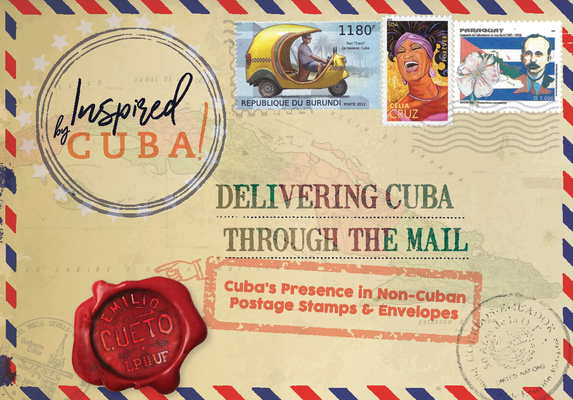
Delivering Cuba Through the Mail : Cuba's Presence in Non-Cuban Postage Stamps and Envelopes
by
Emilio Cueto
Book Details
Format
Paperback / softback
Book Series
Inspired by Cuba
ISBN-10
1944455108
ISBN-13
9781944455101
Publisher
Library Press at UF
Imprint
Library Press at UF
Country of Manufacture
GB
Country of Publication
GB
Publication Date
Nov 10th, 2021
Print length
212 Pages
Weight
854 grams
Dimensions
20.90 x 29.80 x 1.50 cms
Product Classification:
Art styles not defined by dateHistory of artHistory of the AmericasHistory of the Americas
KSh 5,750.00
Temporarily out of stock, due soon
0 in stock
Delivery Location
Delivery fee: Select location
Secure
Quality
Fast
Cuba-related images in Cuban postage stamps is to be expected and comes as no surprise to anyone. Much less known and studied is the fact that, from time to time, Cuba somehow shows up in foreign postage stamps as well as in so-called ‘cinderellas' (resembling stamps, but not issued for postal purposes).
On May 1st, 1840, the United Kingdom issued the first postage stamps in the world: the Penny Black and Two Pence Blue. Other countries soon followed: United States (1847), France and Belgium (1849), Spain, Switzerland, Austria and Prussia (1850), and many more in the ensuing years. In Cuba, then a colony of Spain, the first stamp was used in 1855 and it depicted the image of Queen Isabella II, the sovereign of the Spanish Empire at the time.
In 1899, after Cuba had become separated from Spain and was under US occupation, the first set of Cuban stamps (printed in the US) included an image of Christopher Columbus, who arrived on the island in 1492; a group of Cuban royal palm trees; the statue of an Indian woman representing the island; a rural scene featuring a field plowed by oxen; and a steamship, highlighting Cuba's lifeline to the rest of the world. Cuba was beginning to tell its own story on stamps. And that has been the practice ever since.
As a result, finding Cuba-related images in Cuban postage stamps is to be expected and comes as no surprise to anyone. Much less known and studied is the fact that, from time to time, Cuba somehow shows up in foreign postage stamps as well as in so-called "cinderellas" (resembling stamps, but not issued for postal purposes). It also appears in the design of souvenir sheets outside of the stamps themselves and in the cachets printed on commemorative envelopes and postcards. This is a fascinating story in itself and the one told in this book for the first time.
In 1899, after Cuba had become separated from Spain and was under US occupation, the first set of Cuban stamps (printed in the US) included an image of Christopher Columbus, who arrived on the island in 1492; a group of Cuban royal palm trees; the statue of an Indian woman representing the island; a rural scene featuring a field plowed by oxen; and a steamship, highlighting Cuba's lifeline to the rest of the world. Cuba was beginning to tell its own story on stamps. And that has been the practice ever since.
As a result, finding Cuba-related images in Cuban postage stamps is to be expected and comes as no surprise to anyone. Much less known and studied is the fact that, from time to time, Cuba somehow shows up in foreign postage stamps as well as in so-called "cinderellas" (resembling stamps, but not issued for postal purposes). It also appears in the design of souvenir sheets outside of the stamps themselves and in the cachets printed on commemorative envelopes and postcards. This is a fascinating story in itself and the one told in this book for the first time.
Get Delivering Cuba Through the Mail by Emilio Cueto at the best price and quality guaranteed only at Werezi Africa's largest book ecommerce store. The book was published by Library Press at UF and it has 212 pages.
Customers Who Bought This Also Bought
African Art
KSh 8,550.00

Theorising the Artist Interview
KSh 30,950.00

The Lost Words: Spell Songs
KSh 3,600.00

Maroons in Guyane
KSh 5,700.00

Picturing Cuba
KSh 5,350.00

Reading Underwater Wreckage
KSh 17,450.00

Theorising the Artist Interview
KSh 8,700.00

The Gesamtkunstwerk in Design and Architecture
KSh 8,450.00

Metropolitan Fetish
KSh 7,600.00

Polychrome Art in the Early Modern World
KSh 8,650.00

Praise Songs for Dave the Potter – Art and Poetry for David Drake
KSh 7,650.00

Treasures of Jewish Art
KSh 6,650.00