
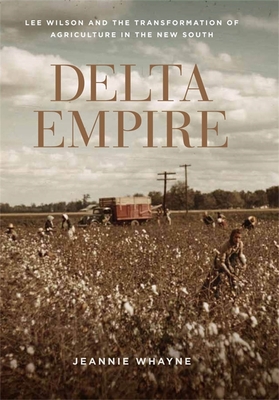
Delta Empire : Lee Wilson and the Transformation of Agriculture in the New South
Book Details
Format
Paperback / softback
Book Series
Making the Modern South
ISBN-10
0807164011
ISBN-13
9780807164013
Publisher
Louisiana State University Press
Imprint
Louisiana State University Press
Country of Manufacture
US
Country of Publication
GB
Publication Date
Feb 22nd, 2016
Print length
320 Pages
Weight
333 grams
Dimensions
22.90 x 15.10 x 1.80 cms
KSh 5,400.00
Currently unavailable
0 in stock
Delivery Location
Delivery fee: Select location
Secure
Quality
Fast
Traces the transition from the labour-intensive sharecropping and tenancy system to the capital-intensive neo-plantations of the post-World War II era to the portfolio plantation model. Through Lee Wilson's story, Whayne provides a case study of strategic innovation and the changing economy of the American south in the late nineteenth century.
In Delta Empire: Lee Wilson and the Transformation of Agriculture in the New South Jeannie Whayne employs the fascinating history of a powerful plantation owner in the Arkansas delta to recount the evolution of southern agriculture from the late nineteenth century through World War II.
After his father's death in 1870, Robert E. ""Lee"" Wilson inherited 400 acres of land in Mississippi County, Arkansas. Over his lifetime, he transformed that inheritance into a 50,000-acre lumber operation and cotton plantation. Early on, Wilson saw an opportunity in the swampy local terrain, which sold for as little as fifty cents an acre, to satisfy an expanding national market for Arkansas forest reserves. He also led the fundamental transformation of the landscape, involving the drainage of tens of thousands of acres of land, in order to create the vast agricultural empire he envisioned.
A consummate manager, Wilson employed the tenancy and sharecropping system to his advantage while earning a reputation for fair treatment of laborers, a reputation, Whayne suggests, not entirely deserved. He cultivated a cadre of relatives and employees from whom he expected absolute devotion. Leveraging every asset during his life and often deeply in debt, Wilson saved his company from bankruptcy several times, leaving it to the next generation to successfully steer the business through the challenges of the 1930s and World War II.
Delta Empire traces the transition from the labor-intensive sharecropping and tenancy system to the capital-intensive neo-plantations of the post-World War II era to the portfolio plantation model. Through Wilson's story Whayne provides a compelling case study of strategic innovation and the changing economy of the South in the late nineteenth century.
After his father's death in 1870, Robert E. ""Lee"" Wilson inherited 400 acres of land in Mississippi County, Arkansas. Over his lifetime, he transformed that inheritance into a 50,000-acre lumber operation and cotton plantation. Early on, Wilson saw an opportunity in the swampy local terrain, which sold for as little as fifty cents an acre, to satisfy an expanding national market for Arkansas forest reserves. He also led the fundamental transformation of the landscape, involving the drainage of tens of thousands of acres of land, in order to create the vast agricultural empire he envisioned.
A consummate manager, Wilson employed the tenancy and sharecropping system to his advantage while earning a reputation for fair treatment of laborers, a reputation, Whayne suggests, not entirely deserved. He cultivated a cadre of relatives and employees from whom he expected absolute devotion. Leveraging every asset during his life and often deeply in debt, Wilson saved his company from bankruptcy several times, leaving it to the next generation to successfully steer the business through the challenges of the 1930s and World War II.
Delta Empire traces the transition from the labor-intensive sharecropping and tenancy system to the capital-intensive neo-plantations of the post-World War II era to the portfolio plantation model. Through Wilson's story Whayne provides a compelling case study of strategic innovation and the changing economy of the South in the late nineteenth century.
Get Delta Empire by Jeannie Whayne at the best price and quality guaranteed only at Werezi Africa's largest book ecommerce store. The book was published by Louisiana State University Press and it has 320 pages.
Customers Who Bought This Also Bought

The Second Emancipation – Nkrumah, Pan–Africanism, and Global Blackness at High Tide
KSh 5,650.00

Maurice and Maralyn
KSh 2,000.00

Crusade for Justice – The Autobiography of Ida B. Wells, Second Edition
KSh 4,050.00

Ecce Homo
KSh 1,800.00

The Life of the Author – Maya Angelou
KSh 3,600.00

Centre Cannot Hold
KSh 3,050.00

Year of Magical Thinking
KSh 2,000.00

Muhammad: His Life Based on the Earliest Sources
KSh 3,600.00

Survive the Savage Sea
KSh 2,600.00

Buckley
KSh 6,250.00

Life in Letters
KSh 5,400.00

Green Hills of Africa
KSh 1,800.00
More in This Genre
The Second Emancipation – Nkrumah, Pan–Africanism, and Global Blackness at High Tide
KSh 5,650.00
Maurice and Maralyn
KSh 2,000.00
Crusade for Justice – The Autobiography of Ida B. Wells, Second Edition
KSh 4,050.00
Ecce Homo
KSh 1,800.00
The Life of the Author – Maya Angelou
KSh 3,600.00
Centre Cannot Hold
KSh 3,050.00
