
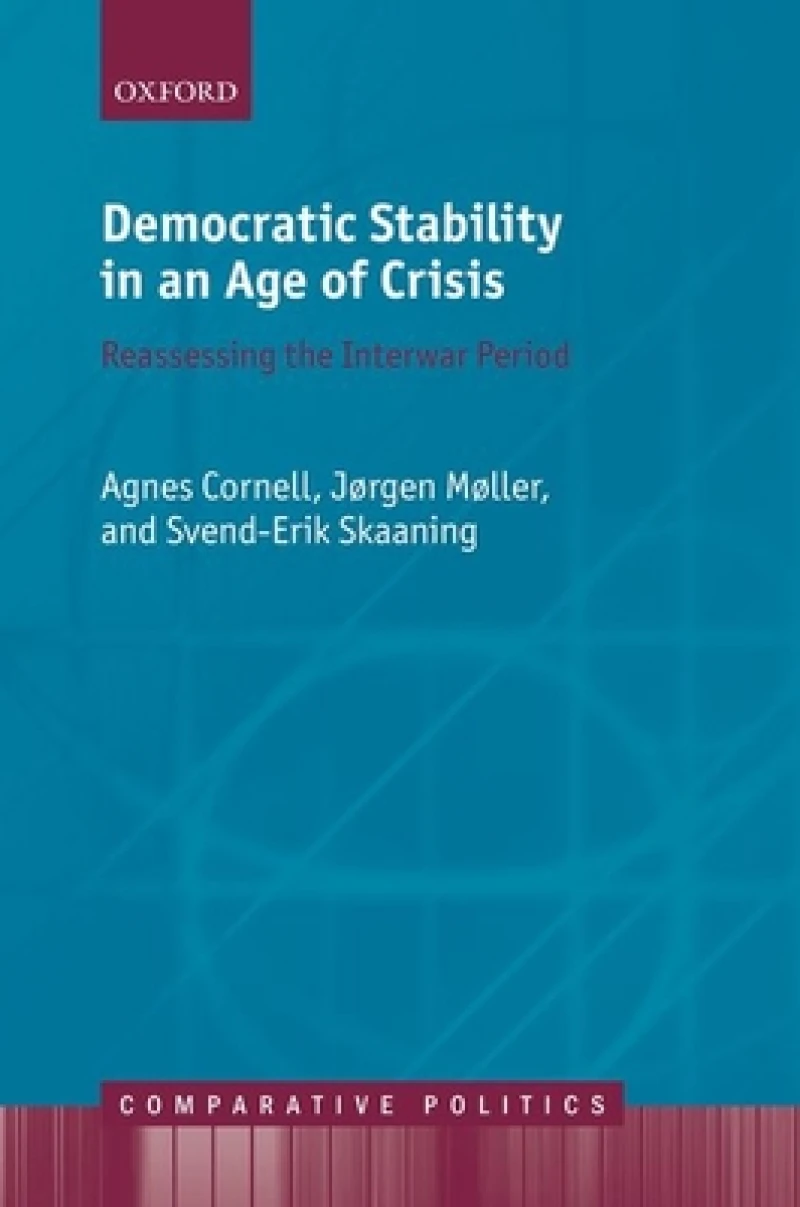
Democratic Stability in an Age of Crisis : Reassessing the Interwar period
Book Details
Format
Hardback or Cased Book
Book Series
Comparative Politics
ISBN-10
0198858248
ISBN-13
9780198858249
Publisher
Oxford University Press
Imprint
Oxford University Press
Country of Manufacture
GB
Country of Publication
GB
Publication Date
Apr 15th, 2020
Print length
256 Pages
Weight
506 grams
Dimensions
24.50 x 16.50 x 2.00 cms
Product Classification:
Comparative politicsPolitical structure & processesGeopoliticsEU & European institutions
Ksh 18,150.00
Werezi Extended Catalogue
0 in stock
Delivery Location
Delivery fee: Select location
Secure
Quality
Fast
This book explains why several democracies during the period between the two world wars broke down and others survived, and examines the extent to which present-day democracies are fragile in the face of crises.
The interwar period has left a deep impression on later generations. This was an age of crises where representative democracy, itself a relatively recent political invention, seemed unable to cope with the challenges that confronted it. Against the backdrop of the economic crisis that began in 2008 and the rise of populist parties, a new body of scholarship - frequently invoked by the media - has used interwar political developments to warn that even long-established Western democracies are fragile. Democratic Stability in an Age of Crisis challenges this ''interwar analogy'' based on the fact that a relatively large number of interwar democracies were able to survive the recurrent crises of the 1920s and 1930s. The main aim of this book is to understand the striking resilience of these democracies, and how they differed from the many democracies that broke down in the same period. The authors advance an explanation that emphasizes the importance of democratic legacies and the strength of the associational landscape (i.e., organized civil society and institutionalized political parties). Moreover, they underline that these factors were themselves associated with a set of deeper structural conditions, which on the eve of the interwar period had brought about different political pathways. The authors'' empirical strategy consists of a combination of comparative analyses of all interwar democratic spells and illustrative case studies. The book''s main takeaway point is that the interwar period shows how resilient democracy is once it has had time to consolidate. On this basis, recent warnings about the fragility of contemporary democracies in Western Europe and North America seem exaggerated - or, at least, that they cannot be sustained by interwar evidence. Comparative Politics is a series for researchers, teachers, and students of political science that deals with contemporary government and politics. Global in scope, books in the series are characterized by a stress on comparative analysis and strong methodological rigour. The series is published in association with the European Consortium for Political Research. For more information visit: www.ecprnet.eu The series is edited by Susan Scarrow, Chair of the Department of Political Science, University of Houston, and Jonathan Slapin, Professor, Department of Political Science, University of Zurich.
Get Democratic Stability in an Age of Crisis by at the best price and quality guaranteed only at Werezi Africa's largest book ecommerce store. The book was published by Oxford University Press and it has pages.

