
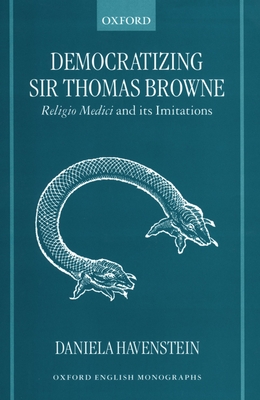
Democratizing Sir Thomas Browne : Religio Medici and its Imitations
Book Details
Format
Hardback
Book Series
Oxford English Monographs
ISBN-10
0198186266
ISBN-13
9780198186267
Publisher
Oxford University Press
Imprint
Clarendon Press
Country of Manufacture
GB
Country of Publication
GB
Publication Date
Nov 25th, 1999
Print length
244 Pages
Weight
438 grams
Dimensions
22.50 x 14.90 x 2.10 cms
Product Classification:
Literary studies: c 1500 to c 1800
KSh 16,300.00
Temporarily out of stock, due soon
0 in stock
Delivery Location
Delivery fee: Select location
Secure
Quality
Fast
This study offers a reconsideration both of the style of "Religio Medici" and of its early reception history, especially as witnessed by a group of late-17th and early 18th-century texts that can loosely be described as "imitations".
Criticism on Sir Thomas Browne is at present in a state of limbo. Little or no attention is paid to his once famous style, while his political attitudes have increasingly jarred with current trends in literary criticism. Democratizing Sir Thomas Browne offers a reconsideration both of Religio Medici''s style and of its early reception history, especially as witnessed by a group of late-seventeenth and early eighteenth-century texts that can loosely be described as ''imitations''. The first part of the book focuses on this hitherto neglected aspect of the reception of Religio Medici, establishing and then analysing examples of imitation, plagiarism, and animadversion, with particular reference to three books which are outstanding in this respect: Sir George Mackenzie''s Religio Stoici(1663), John Dunton and Benjamin Bridgwater''s Religio Bibliopolae (1691), and Richard Burridge''s Religio Libertini (1712). The many and complex responses to Browne''s Religio Medici bear witness to the book''s centrality in the period: examination of these responses permits a more differentiated assessment of the work itself, and a deeper understanding of seventeenth- and early eighteenth-century mentalities. The second part of the book attempts to create a new context for the study of seventeenth-century prose by re-examining Morris W. Croll''s analysis of Browne''s idiom in Religio Medici employing quantitative techniques, the use of which is itself subjected to analysis. Particular attention is paid to word-classes, word-patterns, and lexis. The results of this quantitative investigation are then used as the parameters for comparing the work''s three major ''imitations''. To embed this study into a broader seventeenth-century framework, a group of control writers is also examined: John Donne, Jeremy Taylor, and Richard Baker. Freeing Browne from the corset of previous stylistic criticism, will, it is hoped, pave the way for a reconsideration of his style and that of seventeenth-century prose more generally.
Get Democratizing Sir Thomas Browne by Daniela Havenstein at the best price and quality guaranteed only at Werezi Africa's largest book ecommerce store. The book was published by Oxford University Press and it has 244 pages.
Customers Who Bought This Also Bought
Arabian Nights'' Entertainments
KSh 2,950.00
Robinson Crusoe
KSh 1,450.00
Metaphysical Poetry
KSh 2,350.00
A Portrait of the Artist as a Young Man
KSh 1,250.00

Shakespeare Book
KSh 4,250.00
Don Quixote de la Mancha
KSh 2,150.00
Lorna Doone
KSh 2,000.00
Tom Jones
KSh 5,400.00
Tom Jones
KSh 2,250.00
Micromégas and Other Short Fictions
KSh 2,350.00
Murder Among Friends
KSh 22,750.00

Hamlet: Poem Unlimited
KSh 1,800.00
