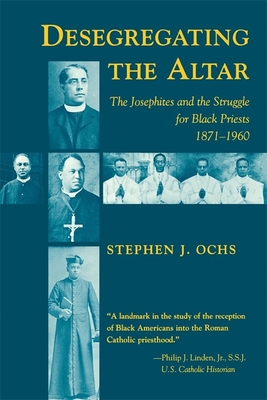
Desegregating the Altar : The Josephites and the Struggle for Black Priests, 1871-1960
Book Details
Format
Paperback / softback
ISBN-10
0807118591
ISBN-13
9780807118597
Publisher
Louisiana State University Press
Imprint
Louisiana State University Press
Country of Manufacture
US
Country of Publication
GB
Publication Date
Jul 1st, 1993
Print length
488 Pages
Weight
699 grams
Dimensions
22.80 x 15.10 x 2.80 cms
Product Classification:
Roman Catholicism, Roman Catholic ChurchRoman Catholicism, Roman Catholic Church
KSh 6,850.00
Currently unavailable
0 in stock
Delivery Location
Delivery fee: Select location
Secure
Quality
Fast
Drawing on extensive research in the previously closed or unavailable archives of numerous archdioceses, diocese, and religious communities, Stephen Ochs shows that, in many cases, Roman catholic authorities purposely excluded Afro-Americans from their seminaries.
Historically, black Americans have affiliated in far greater numbers with certain protestant denominations than with the Roman Catholic church. In analysing this phenomenon scholars have sometimes alluded to the dearth of black Catholic priest, but non one has adequately explained why the church failed to ordain significant numbers of black clergy until the 1930s. Desegregating the Altar, a broadly based study encompassing Afro-American, Roman catholic, southern, and institutional history, fills that gap by examining the issue through the experience of St. Joseph's Society of the Sacred Heart, or the Josephites, the only American community of Catholic priests devoted exclusively to evangelization of blacks.
Drawing on extensive research in the previously closed or unavailable archives of numerous archdioceses, diocese, and religious communities, Stephen J. Ochs shows that, in many cases, Roman catholic authorities purposely excluded Afro-Americans from their seminaries. The conscious pattern of discrimination on the part of numerous bishops and heads of religious institutes stemmed from a number of factors, including the church's weak and vulnerable position in the South and the consequent reluctance of its leaders to challenge local racial norms; the tendency of Roman Catholics to accommodate to the regional and national cultures in which they lived; deep-seated psychosexual fears that black men would be unable to maintain celibacy as priests; and a ""missionary approach"" to blacks that regarded them as passive children rather than as potential partners and leaders.
The Josephites, under the leadership of John R. Slattery, their first superior general (1893-1903), defied prevailing racist sentiment by admitting blacks into their college and seminary and raising three of them to the priesthood between 1891 and 1907. This action proved so explosive, however, that it helped drive Slattery out of the church and nearly destroyed the Josephite community. In the face of such opposition, Josephite authorities closed their college and seminary to black candidates except for an occasional mulatto. Leadership in the development of a black clergy thereupon passed to missionaries of the Society of the Diving Word. Meanwhile, Afro-American Catholics, led by Professor Thomas Wyatt, refused to allow the Josephites to abandon the filed quietly. They formed the Federated coloured Catholics of America and pressed the Josephites to return to their earlier policies; they also communicated their grievances to the Holy See, which, in turn, quietly pressured the American church to open its seminaries to black candidates. As a result, by 1960, the number of black priests and seminarians in the Josephites and throughout the Catholic church in the United States had increased significantly.
Stephen Ochs's study of the Josephites illustrates the tenacity and insidiousness of institutional racism and the tendency of churches to opt for institutional security rather than a prophetic stance in the face of controversial social issues. His book ably demonstrates that the struggle of black Catholics for priests of their own race mirrored the efforts of Afro-Americans throughout American society to achieve racial equality and justice.
Drawing on extensive research in the previously closed or unavailable archives of numerous archdioceses, diocese, and religious communities, Stephen J. Ochs shows that, in many cases, Roman catholic authorities purposely excluded Afro-Americans from their seminaries. The conscious pattern of discrimination on the part of numerous bishops and heads of religious institutes stemmed from a number of factors, including the church's weak and vulnerable position in the South and the consequent reluctance of its leaders to challenge local racial norms; the tendency of Roman Catholics to accommodate to the regional and national cultures in which they lived; deep-seated psychosexual fears that black men would be unable to maintain celibacy as priests; and a ""missionary approach"" to blacks that regarded them as passive children rather than as potential partners and leaders.
The Josephites, under the leadership of John R. Slattery, their first superior general (1893-1903), defied prevailing racist sentiment by admitting blacks into their college and seminary and raising three of them to the priesthood between 1891 and 1907. This action proved so explosive, however, that it helped drive Slattery out of the church and nearly destroyed the Josephite community. In the face of such opposition, Josephite authorities closed their college and seminary to black candidates except for an occasional mulatto. Leadership in the development of a black clergy thereupon passed to missionaries of the Society of the Diving Word. Meanwhile, Afro-American Catholics, led by Professor Thomas Wyatt, refused to allow the Josephites to abandon the filed quietly. They formed the Federated coloured Catholics of America and pressed the Josephites to return to their earlier policies; they also communicated their grievances to the Holy See, which, in turn, quietly pressured the American church to open its seminaries to black candidates. As a result, by 1960, the number of black priests and seminarians in the Josephites and throughout the Catholic church in the United States had increased significantly.
Stephen Ochs's study of the Josephites illustrates the tenacity and insidiousness of institutional racism and the tendency of churches to opt for institutional security rather than a prophetic stance in the face of controversial social issues. His book ably demonstrates that the struggle of black Catholics for priests of their own race mirrored the efforts of Afro-Americans throughout American society to achieve racial equality and justice.
Get Desegregating the Altar by Stephen J. Ochs at the best price and quality guaranteed only at Werezi Africa's largest book ecommerce store. The book was published by Louisiana State University Press and it has 488 pages.
Customers Who Bought This Also Bought
Magnifica Humanitas
KSh 1,500.00
Hope
KSh 4,500.00
Good Life
KSh 2,350.00

In God's Name
KSh 2,350.00

Leo XIV
KSh 3,600.00

NRSV, Catholic Bible, Thinline Edition, Leathersoft, Brown, Comfort Print
KSh 7,200.00

NABRE, New American Bible, Revised Edition, Catholic Bible, Large Print Edition, Leathersoft, Brown, Comfort Print
KSh 10,850.00

NRSV Catholic Edition Bible, Royal Poinciana Paperback (Global Cover Series)
KSh 3,150.00
Understanding Divine Mercy
KSh 2,500.00

Modern Classics Edmund Campion Jesuit and Martyr
KSh 1,800.00
The History of the Decline and Fall of the Roman Empire
KSh 2,900.00

Sign of the Cross
KSh 2,000.00