
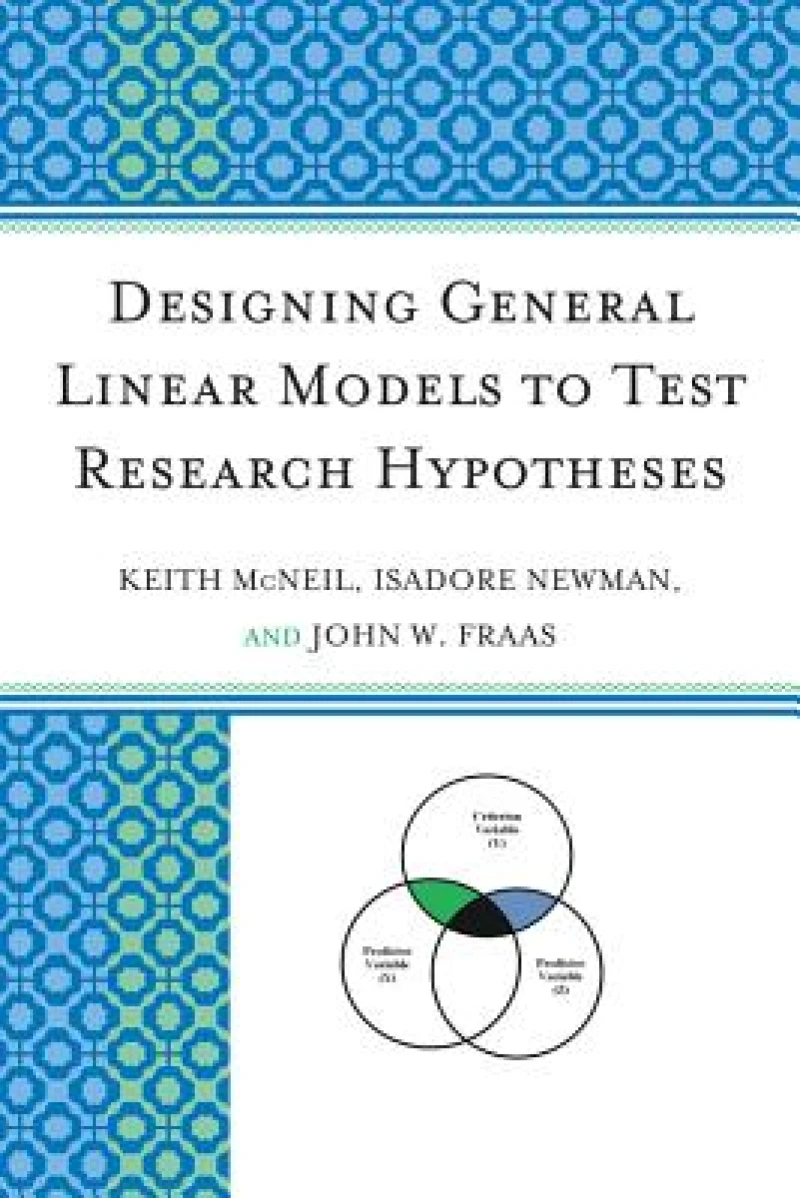
Designing General Linear Models to Test Research Hypotheses
Book Details
Format
Paperback / Softback
ISBN-10
0761857680
ISBN-13
9780761857686
Publisher
University Press of America
Imprint
University Press of America
Country of Manufacture
GB
Country of Publication
GB
Publication Date
Dec 14th, 2011
Print length
494 Pages
Weight
735 grams
Dimensions
23.20 x 15.50 x 3.50 cms
Product Classification:
Research & development managementMathematicsProbability & statistics
Ksh 12,250.00
Manufactured on Demand
Delivery in 29 days
Delivery Location
Delivery fee: Select location
Delivery in 29 days
Secure
Quality
Fast
The focus of this text is placed on designing General Linear Models (regression models) to test research hypotheses. The authors illustrate and discuss General Linear Models specifically designed to statistically test research hypotheses that deal with the differences among group means, relationships between continuous variables, analysis of covariance, interaction effects, nonlinear relationships, and repeated measures. Many of the chapters contain sections entitled “General Hypothesis” and “Applied Hypothesis.” The General Hypothesis sections are designed to provide the readers with “road maps” regarding how to conduct the various analyses presented in the text. The Applied Hypothesis sections illustrate how the various analyses are conducted with Microsoft Excel and SPSS for Windows and how the outputs should be interpreted to test the hypotheses. Throughout the text, the authors stress the importance of designing regression models that precisely reflect the null and research hypotheses.
Get Designing General Linear Models to Test Research Hypotheses by at the best price and quality guaranteed only at Werezi Africa's largest book ecommerce store. The book was published by University Press of America and it has pages.

