
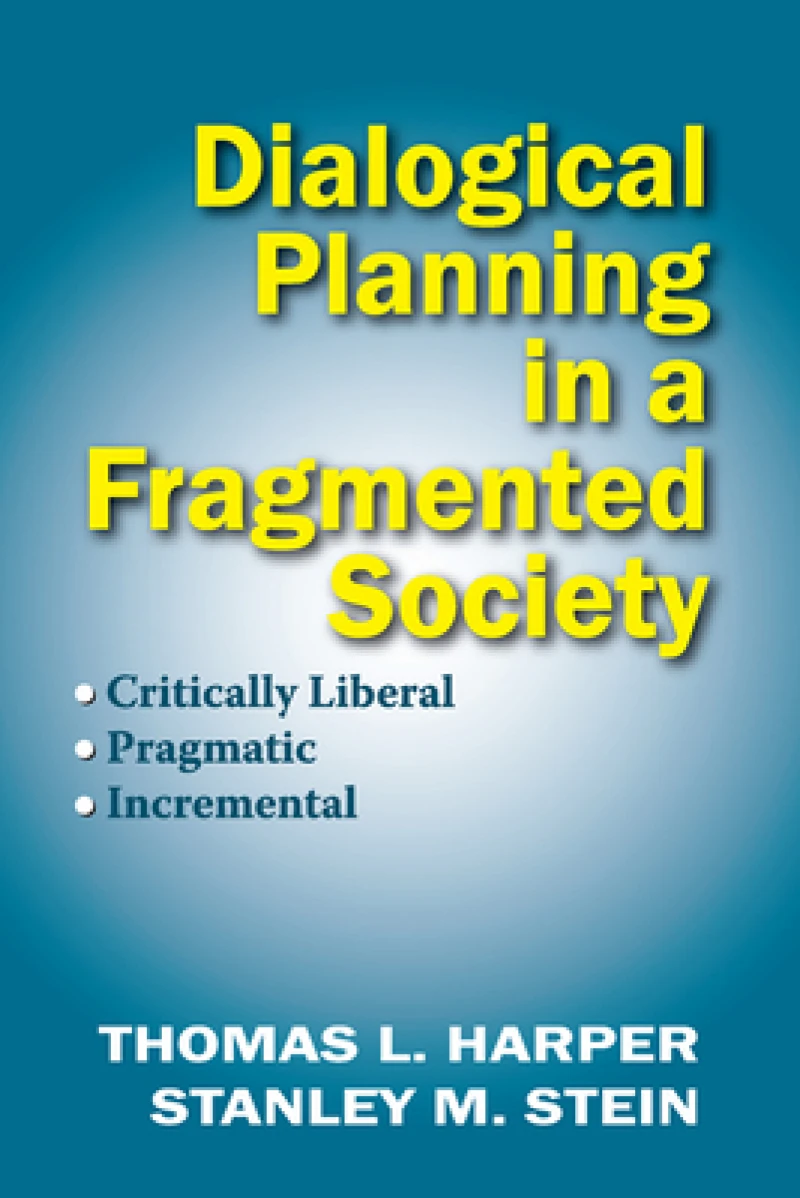
Dialogical Planning in a Fragmented Society : Critically Liberal, Pragmatic, Incremental
Book Details
Format
Paperback / Softback
ISBN-10
0882851799
ISBN-13
9780882851792
Publisher
Rutgers University Press
Imprint
Centre for Urban Policy Research,U.S.
Country of Manufacture
GB
Country of Publication
GB
Publication Date
Oct 15th, 2005
Print length
374 Pages
Weight
516 grams
Dimensions
22.90 x 16.00 x 2.00 cms
Product Classification:
Urban communitiesCentral government policiesUrban & municipal planning
Ksh 5,900.00
Werezi Extended Catalogue
0 in stock
Delivery Location
Delivery fee: Select location
Secure
Quality
Fast
The culmination of a critical study of neo-pragmatism philosophy and its application to planning, Dialogical Planning in a Fragmented Society begins with philosopher Stanley M. Stein''s examination of neo-pragmatism and his thoughts on how it can be useful in the field of environmental design-specifically, how it can be applied to planning procedures and problems. Neo-pragmatism is an approach that has been, in the past, best expressed or implied in the writing of Hilary Putnam, Richard Rorty, and, in particular, Donald Davidson, John Rawls, and Ludwig Wittgenstein. Thomas L. Harper furthers this tradition by providing the context for this theoretical application from his academic background in economics and management as well as his practical experience with political decision-making processes, community planning, and economic development. The result is a fresh synthesis of ideas-a new approach to thinking about planning theory and its implications for, and relationship with, practice. Philosopher Michael Walzer has asserted that "philosophy reflects and articulates the political culture of its time, and politics presents and enacts the arguments of philosophy." Similarly, the authors view planning theory as planning reflected upon in tranquility, away from the tumult of battle, and planning practice as planning theory acted out in the confusion of the trenches. Each changes the other in a dynamic way, and the authors demonstrate the intimate and inextricable link between them.
The culmination of a critical study of neo-pragmatism philosophy and its application to planning, Dialogical Planning in a Fragmented Society begins with philosopher Stanley M. Stein''s examination of neo-pragmatism and his thoughts on how it can be useful in the field of environmental design-specifically, how it can be applied to planning procedures and problems. Neo-pragmatism is an approach that has been, in the past, best expressed or implied in the writing of Hilary Putnam, Richard Rorty, and, in particular, Donald Davidson, John Rawls, and Ludwig Wittgenstein. Thomas L. Harper furthers this tradition by providing the context for this theoretical application from his academic background in economics and management as well as his practical experience with political decision-making processes, community planning, and economic development. The result is a fresh synthesis of ideas-a new approach to thinking about planning theory and its implications for, and relationship with, practice. Philosopher Michael Walzer has asserted that "philosophy reflects and articulates the political culture of its time, and politics presents and enacts the arguments of philosophy." Similarly, the authors view planning theory as planning reflected upon in tranquility, away from the tumult of battle, and planning practice as planning theory acted out in the confusion of the trenches. Each changes the other in a dynamic way, and the authors demonstrate the intimate and inextricable link between them.
Get Dialogical Planning in a Fragmented Society by at the best price and quality guaranteed only at Werezi Africa's largest book ecommerce store. The book was published by Rutgers University Press and it has pages.

