
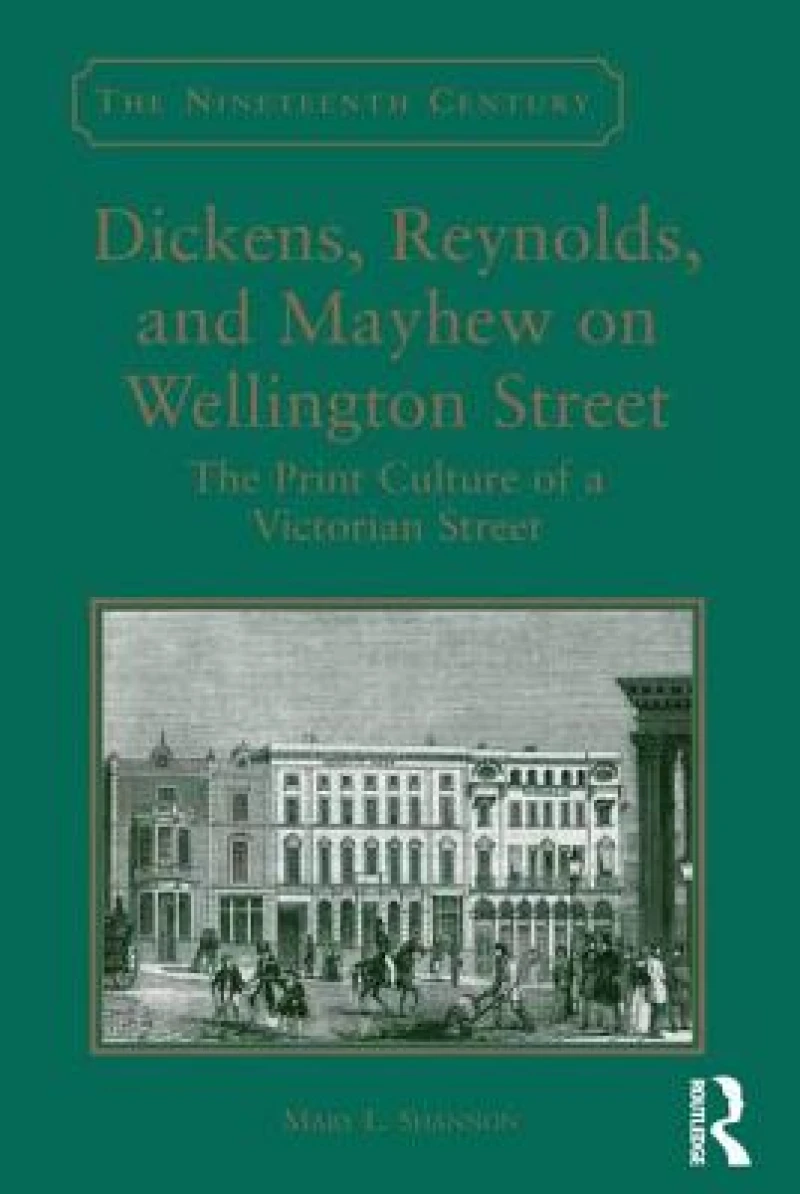
Dickens, Reynolds, and Mayhew on Wellington Street : The Print Culture of a Victorian Street
Book Details
Format
Hardback or Cased Book
Book Series
The Nineteenth Century Series
ISBN-10
1472442040
ISBN-13
9781472442048
Publisher
Taylor & Francis Ltd
Imprint
Routledge
Country of Manufacture
GB
Country of Publication
GB
Publication Date
Apr 28th, 2015
Print length
278 Pages
Weight
660 grams
Dimensions
24.30 x 16.40 x 2.40 cms
Ksh 30,950.00
Werezi Extended Catalogue
0 in stock
Delivery Location
Delivery fee: Select location
Secure
Quality
Fast
Between 1843 and 1853, Household Words, Reynoldss Weekly Newspaper, the Examiner, Punch, and the serial edition of London Labour and the London Poor were all published from Wellington Street off the Strand, which housed the offices of Charles Dickens, G.W.M. Reynolds and Henry Mayhew. Shannon examines the implications of their close proximity for the editors themselves, for nineteenth-century publishing, and for the reading public.
A glance over the back pages of mid-nineteenth-century newspapers and periodicals published in London reveals that Wellington Street stands out among imprint addresses. Between 1843 and 1853, Household Words, Reynoldss Weekly Newspaper, the Examiner, Punch, the Athenaeum, the Spectator, the Morning Post, and the serial edition of London Labour and the London Poor, to name a few, were all published from this short street off the Strand. Mary L. Shannon identifies, for the first time, the close proximity of the offices of Charles Dickens, G.W.M. Reynolds, and Henry Mayhew, examining the ramifications for the individual authors and for nineteenth-century publishing. What are the implications of Charles Dickens, his arch-competitor the radical publisher G.W.M. Reynolds, and Henry Mayhew being such close neighbours? Given that London was capital of more than Britain alone, what connections does Wellington Street reveal between London print networks and the print culture and networks of the wider empire? How might the editors experiences make us rethink the ways in which they and others addressed their anonymous readers as friends, as if they were part of their immediate social network? As Shannon shows, readers in the London of the 1840s and ''50s, despite advances in literacy, print technology, and communications, were not simply an imagined community of individuals who read in silent privacy, but active members of an imagined network that punctured the anonymity of the teeming city and even the empire.
Get Dickens, Reynolds, and Mayhew on Wellington Street by at the best price and quality guaranteed only at Werezi Africa's largest book ecommerce store. The book was published by Taylor & Francis Ltd and it has pages.

