
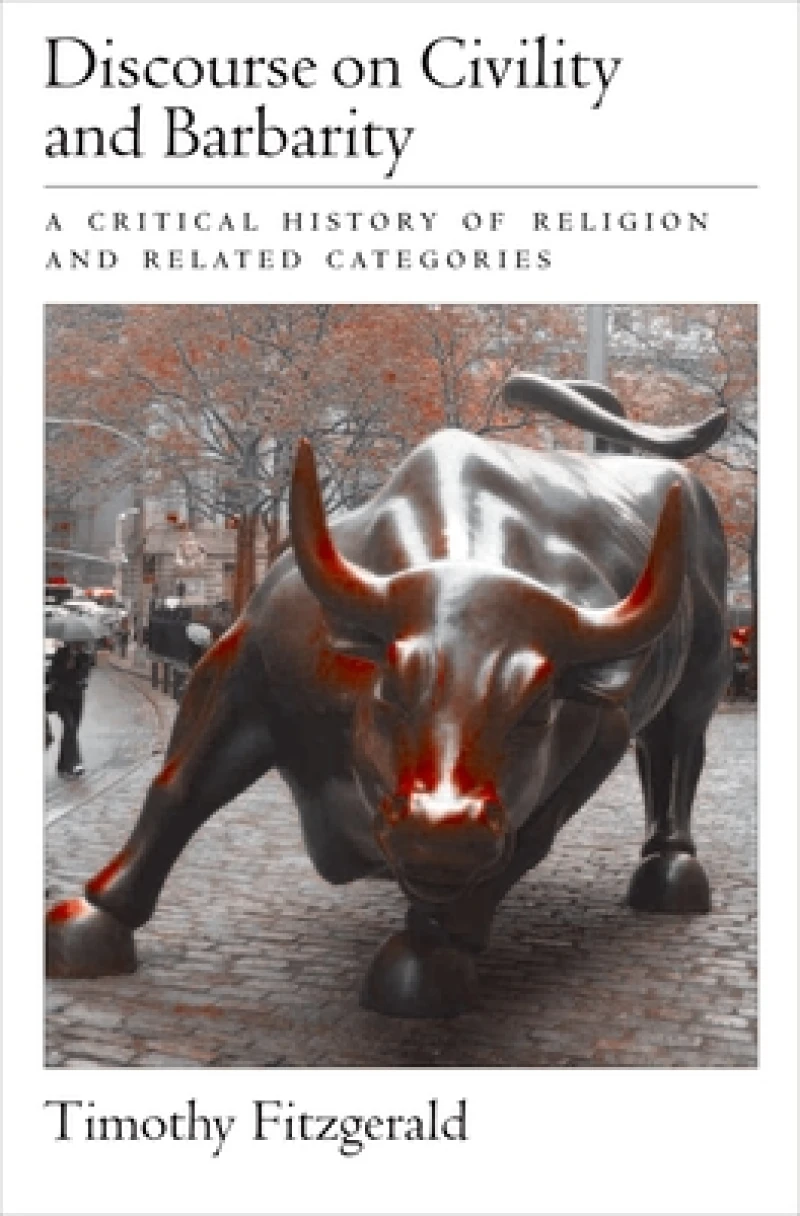
Discourse on Civility and Barbarity
Book Details
Format
Hardback or Cased Book
ISBN-10
0195300092
ISBN-13
9780195300093
Publisher
Oxford University Press Inc
Imprint
Oxford University Press Inc
Country of Manufacture
US
Country of Publication
GB
Publication Date
Dec 6th, 2007
Print length
368 Pages
Weight
686 grams
Dimensions
16.30 x 23.60 x 3.60 cms
Product Classification:
Philosophy of religionComparative religionPolitics & government
Ksh 6,650.00
Manufactured on Demand
0 in stock
Delivery Location
Delivery fee: Select location
Secure
Quality
Fast
This book analyses the development of different meanings of the term ''religion'' in different contexts and in relation to other categories with shifting and unstable nuances such as the state, politics, economics, and the secular. It traces a major transformation of the category as a function of Euro-American colonialism and capitalism from its traditional meaning of Christian Truth to the modern generic and pluralised category of religions and world religions. Throughout the period under consideration discourses on religion have overlapped significantly with discourses on ''our'' civility as opposed to ''their'' barbarity, underpinning the superior rationality of the literate male elite of western societies.
In recent years scholars have begun to question the usefulness of the category of ''''religion'''' to describe a distinctive form of human experience and behavior. In his last book, The Ideology of Religious Studies (OUP 2000), Timothy Fitzgerald argued that ''''religion'''' was not a private area of human existence that could be separated from the public realm and that the study of religion as such was thus impossibility. In this new book he examines a wide range of English language texts to show how religion became transformed from a very specific category indigenous to Christian culture into a universalist claim about human nature and society. These claims, he shows, are implied by and frequently explicit in theories and methods of comparative religion. But they are also tacitly reproduced throughout the humanities in the relatively indiscriminate use of ''''religion'''' as an a priori valid cross-cultural analytical concept, for example in historiography, sociology, and social anthropology. Fitzgerald seeks to link the argument about religion to the parallel formation of the ''''non-religious'''' and such dichotomies as church-state, sacred-profane, ecclesiastical-civil, spiritual-temporal, supernatural-natural, and irrational-rational. Part of his argument is that the category ''''religion'''' has a different logic compared to the category ''''sacred,'''' but the two have been consistently confused by major writers, including Durkheim and Eliade. Fitzgerald contends that ''''religion'''' imagined as a private belief in the supernatural was a necessary conceptual space for the simultaneous imagining of ''''secular'''' practices and institutions such as politics, economics, and the Nation State. The invention of ''''religion'''' as a universal type of experience, practice, and institution was partly the result of sacralizing new concepts of exchange, ownership, and labor practices, applying ''''scientific'''' rationality to human behavior, administering the colonies and classifying native institutions. In contrast, shows Fitzgerald, the sacred-profane dichotomy has a different logic of use.
Get Discourse on Civility and Barbarity by at the best price and quality guaranteed only at Werezi Africa's largest book ecommerce store. The book was published by Oxford University Press Inc and it has pages.

