
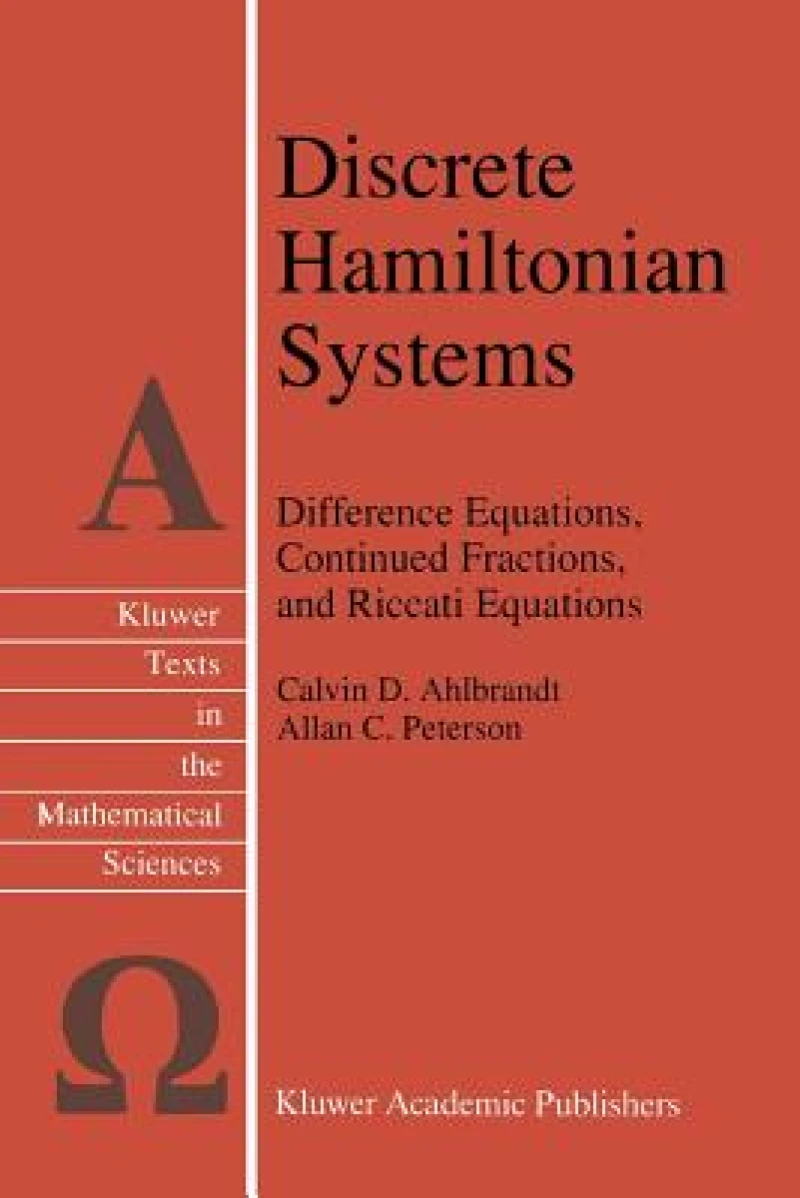
Discrete Hamiltonian Systems : Difference Equations, Continued Fractions, and Riccati Equations
Softcover reprint of the original 1st ed. 1996
Book Details
Format
Paperback / Softback
Book Series
Texts in the Mathematical Sciences
ISBN-10
1441947639
ISBN-13
9781441947635
Edition
Softcover reprint of the original 1st ed. 1996
Publisher
Springer-Verlag New York Inc.
Imprint
Springer-Verlag New York Inc.
Country of Manufacture
GB
Country of Publication
GB
Publication Date
Dec 8th, 2010
Print length
376 Pages
Product Classification:
Differential calculus & equationsDifferential calculus and equationsOptimization
Ksh 45,000.00
Werezi Extended Catalogue
0 in stock
Delivery Location
Delivery fee: Select location
Secure
Quality
Fast
In particular, the material of the chapters on continued fractions (Chapter 2), symplectic systems (Chapter 3), and discrete variational theory (Chapter 4) summarize recent literature. Similarly, the material on transforming Riccati equations presented in Chapter 3 gives a self-contained unification of various forms of Riccati equations.
This book should be accessible to students who have had a first course in matrix theory. The existence and uniqueness theorem of Chapter 4 requires the implicit function theorem, but we give a self-contained constructive proof ofthat theorem. The reader willing to accept the implicit function theorem can read the book without an advanced calculus background. Chapter 8 uses the Moore-Penrose pseudo-inverse, but is accessible to students who have facility with matrices. Exercises are placed at those points in the text where they are relevant. For U. S. universities, we intend for the book to be used at the senior undergraduate level or beginning graduate level. Chapter 2, which is on continued fractions, is not essential to the material of the remaining chapters, but is intimately related to the remaining material. Continued fractions provide closed form representations of the extreme solutions of some discrete matrix Riccati equations. Continued fractions solution methods for Riccati difference equations provide an approach analogous to series solution methods for linear differential equations. The book develops several topics which have not been available at this level. In particular, the material of the chapters on continued fractions (Chapter 2), symplectic systems (Chapter 3), and discrete variational theory (Chapter 4) summarize recent literature. Similarly, the material on transforming Riccati equations presented in Chapter 3 gives a self-contained unification of various forms of Riccati equations. Motivation for our approach to difference equations came from the work of Harris, Vaughan, Hartman, Reid, Patula, Hooker, Erbe & Van, and Bohner.
Get Discrete Hamiltonian Systems by at the best price and quality guaranteed only at Werezi Africa's largest book ecommerce store. The book was published by Springer-Verlag New York Inc. and it has pages.

