
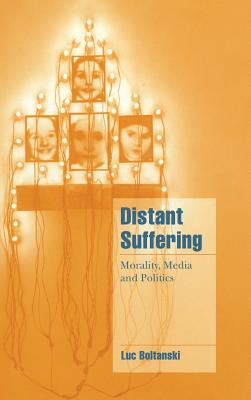
Distant Suffering : Morality, Media and Politics
Book Details
Format
Hardback
Book Series
Cambridge Cultural Social Studies
ISBN-10
0521573890
ISBN-13
9780521573894
Publisher
Cambridge University Press
Imprint
Cambridge University Press
Country of Manufacture
GB
Country of Publication
GB
Publication Date
Oct 28th, 1999
Print length
266 Pages
Weight
535 grams
Dimensions
24.00 x 15.80 x 2.60 cms
Product Classification:
Cultural studiesMedia studiesCultural studiesMedia studiesAnthropology
KSh 16,900.00
Currently unavailable
0 in stock
Delivery Location
Delivery fee: Select location
Secure
Quality
Fast
What is the morally acceptable response to images of starving children, bombed villages and mass graves brought to us by television? Luc Boltanski discusses the ways in which spectators have tried to respond to what they have seen and asks if there remains a place for pity in modern politics.
Distant Suffering, first published in 1999, examines the moral and political implications for a spectator of the distant suffering of others as presented through the media. What are the morally acceptable responses to the sight of suffering on television, for example, when the viewer cannot act directly to affect the circumstances in which the suffering takes place? Luc Boltanski argues that spectators can actively involve themselves and others by speaking about what they have seen and how they were affected by it. Developing ideas in Adam Smith's moral theory, he examines three rhetorical 'topics' available for the expression of the spectator's response to suffering: the topics of denunciation and of sentiment and the aesthetic topic. The book concludes with a discussion of a 'crisis of pity' in relation to modern forms of humanitarianism. A possible way out of this crisis is suggested which involves an emphasis and focus on present suffering.
Get Distant Suffering by Luc Boltanski at the best price and quality guaranteed only at Werezi Africa's largest book ecommerce store. The book was published by Cambridge University Press and it has 266 pages.
Customers Who Bought This Also Bought

Decolonising the Mind
KSh 4,700.00
Message
KSh 3,400.00

The Culture Map
KSh 3,050.00

Between The World And Me
KSh 2,000.00

Orientalism
KSh 2,350.00
Culture and Imperialism
KSh 2,700.00

Africa Is Not A Country
KSh 2,350.00

White Album
KSh 2,000.00

Moving the Centre
KSh 4,850.00

The Case for Christ
KSh 1,450.00

A Brief History of Equality
KSh 2,850.00

War Against Cliche
KSh 2,700.00
More by Luc Boltanski

Prime Éducation Et Morale De Classe
KSh 19,000.00

Love and Justice as Competences
KSh 3,750.00

The Foetal Condition – A Sociology of Engendering and Abortion
KSh 10,800.00

The Making of Public Space
KSh 3,650.00

Enrichment – A Critique of Commodities
KSh 6,700.00
Distant Suffering
KSh 4,400.00

The New Spirit of Capitalism
KSh 7,200.00

Mysteries and Conspiracies
KSh 4,700.00
On Justification – Economies of Worth
KSh 10,450.00

On Critique
KSh 3,300.00

Mysteries and Conspiracies – Detective Stories, Spy Novels and the Making of Modern Societies
KSh 9,900.00

The Making of Public Space
KSh 9,900.00
