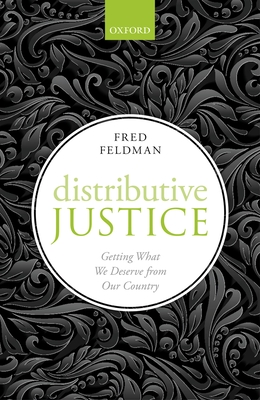
Distributive Justice : Getting What We Deserve From Our Country
by
Fred Feldman
Book Details
Format
Hardback
ISBN-10
0198782985
ISBN-13
9780198782988
Publisher
Oxford University Press
Imprint
Oxford University Press
Country of Manufacture
GB
Country of Publication
GB
Publication Date
Jul 14th, 2016
Print length
280 Pages
Weight
564 grams
Dimensions
23.80 x 17.80 x 2.20 cms
KSh 13,600.00
Not Yet Published
0 in stock
Delivery Location
Delivery fee: Select location
Secure
Quality
Fast
This book presents and defends a novel theory of distributive justice, according to which political economic distributive justice reigns in a state if the government of that state ensures that citizens receive the benefits and burdens they deserve from it.
This book presents and defends a novel theory of distributive justice, according to which political economic distributive justice reigns in a state if the government of that state ensures that citizens receive the benefits and burdens they deserve from it. The book starts with a more precise characterization of the target of this inquiry - political economic distributive justice. It then proceeds to explicate the concept of desert, evaluate proposed ways of justifying desert claims, formulate a number of desertist theories of justice, and draw out the special features of the version defended here. Once the proposed form of desertism has been stated, its implications are compared to those of egalitarianism, luck egalitarianism, sufficientism, the difference principle, libertarianism, and prioritarianism, with the aim of showing that desertism yields more attractive results in cases that prove difficult for other theories currently being discussed in the literature. Arguments - especially arguments deriving from Rawls -- against desertism are explained and shown to be ineffective. There is discussion of the distinction between comparative and non-comparative justice. Emphasis is placed on the distinction between (a) theories about the moral rightness of distributions, (b) theories about the intrinsic value of distributions, and (c) theories specifically about the justice of distributions. There is discussion of the unfortunate results of confusion of these different sorts of theory. The views of Rawls, Nozick, Parfit, Frankfurt, Feinberg and others are discussed. A version of the method of reflective equilibrium is explained and defended. The book concludes with a series of admissions concerning puzzles that remain unsolved.
Get Distributive Justice by Fred Feldman at the best price and quality guaranteed only at Werezi Africa's largest book ecommerce store. The book was published by Oxford University Press and it has 280 pages.
Customers Who Bought This Also Bought

Xmeditations
KSh 700.00
Groundwork for the Metaphysics of Morals
KSh 2,000.00
On the Genealogy of Morals
KSh 2,000.00
Beyond Good and Evil
KSh 2,000.00
The Nicomachean Ethics
KSh 1,600.00

The Sovereignty of Good
KSh 5,400.00

Justice
KSh 2,000.00

Meditations
KSh 1,600.00

What We Owe The Future
KSh 2,000.00

The Analects
KSh 2,350.00

How to Be a Leader – An Ancient Guide to Wise Leadership
KSh 2,800.00

There Are Places in the World Where Rules Are Less Important Than Kindness
KSh 3,600.00