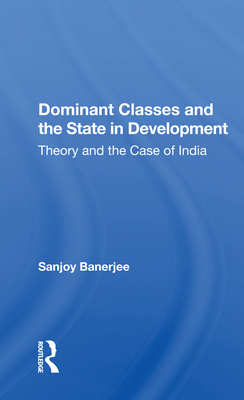
Dominant Classes And The State In Development : Theory and the Case of India
Book Details
Format
Hardback
ISBN-10
0367019906
ISBN-13
9780367019907
Publisher
Taylor & Francis Ltd
Imprint
Routledge
Country of Manufacture
GB
Country of Publication
GB
Publication Date
Jun 7th, 2019
Print length
128 Pages
Weight
400 grams
Product Classification:
Sociology
KSh 30,950.00
Currently unavailable
0 in stock
Delivery Location
Delivery fee: Select location
Secure
Quality
Fast
Why does capitalist development give rise to political alliances between the state and certain economically dominant classes? Addressing this question, Professor Banerjee uses an evolutionary approach to social structure to develop a theory of the interaction within and among business and manufacturing firms--a theory that highlights those aspects of market processes that promote the formation of dominant economic classes. Structural-evolutionary conceptions of property relations and of state planning and regulation are developed and combined with the market model. According to Professor Banerjee, the market, property relations, and state administration form a self-sustaining structure that simultaneously develops the economy in an uneven and clustered fashion and gives rise to a "dominant alliance" between a segment of the state and the fastest-accumulating classes in the economy. He applies his model to India during the 1956-1975 period, examining the industrialization process of the Second and Third plans, the crisis of the mid-1960s, and the Green Revolution.
Get Dominant Classes And The State In Development by Sanjoy Banerjee at the best price and quality guaranteed only at Werezi Africa's largest book ecommerce store. The book was published by Taylor & Francis Ltd and it has 128 pages.
Customers Who Bought This Also Bought

Caste
KSh 2,700.00

On Freedom
KSh 2,350.00

Extinction of Experience
KSh 3,950.00

Revenge of the Tipping Point
KSh 2,350.00

Lost Girls
KSh 2,000.00

Right to Sex
KSh 2,000.00

Caste
KSh 4,550.00

Revenge of the Tipping Point
KSh 4,500.00

Revenge of the Tipping Point
KSh 3,050.00

Can Feminism Be African
KSh 2,000.00

Can Feminism Be African
KSh 3,950.00

History of Sexuality: 2
KSh 2,350.00