
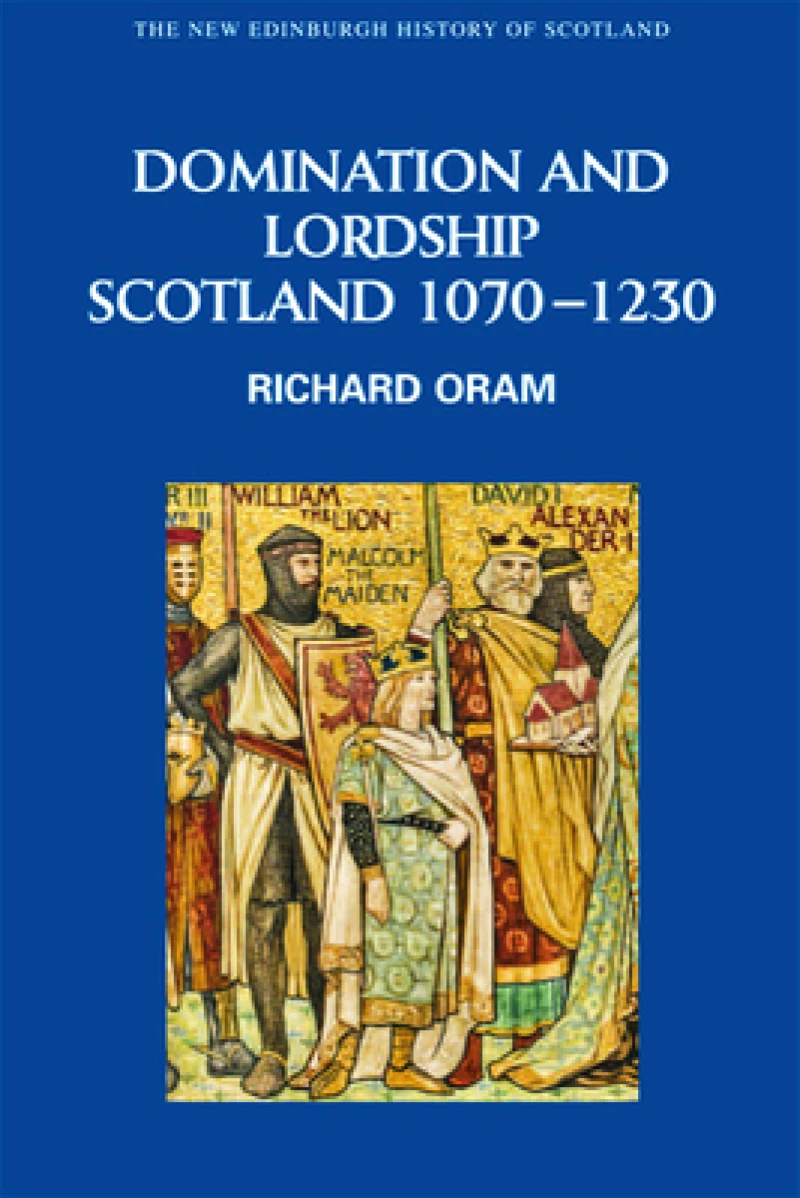
Domination and Lordship : Scotland, 1070-1230
by
Richard Oram
Book Details
Format
Hardback or Cased Book
ISBN-10
0748614966
ISBN-13
9780748614967
Publisher
Edinburgh University Press
Imprint
Edinburgh University Press
Country of Manufacture
GB
Country of Publication
GB
Publication Date
Feb 21st, 2011
Print length
448 Pages
Weight
834 grams
Dimensions
24.20 x 16.60 x 4.00 cms
Product Classification:
British & Irish historyEarly history: c 500 to c 1450/1500
Ksh 21,600.00
Manufactured on Demand
0 in stock
Delivery Location
Delivery fee: Select location
Secure
Quality
Fast
This book discussed the processes by which the Gaelic kingdom of Alba established its mastery over the lesser kingdoms of northern mainland Britain and transformed itself into a state recognisable as Scotland.
This volume centres upon the era conventionally labelled the ''Making of the kingdom'', or the ''Anglo-Norman'' era in Scottish history. It seeks a balance between traditional historiographical concentration on the ''feudalisation'' of Scottish society as part of the wholesale importation of alien cultural traditions by a ''modernising'' monarchy and more recent emphasis on the continuing vitality and centrality of Gaelic culture and traditions within the twelfth- and early thirteenth-century kingdom.
Part I explores the transition from the Gaelic kingship of Alba into the hybridised medieval state and traces Scotland''s role as both dominated and dominator. It examines the redefinition of relationships with England, Gaelic magnates within Scotland''s traditional territorial heartland and with autonomous/independent mainland and insular powers. These interrelationships form the central theme of an exploration of the struggle for political domination of the northern mainland of Britain and the adjacent islands, the mechanisms through which that domination was projected and expressed, and the manner of its expression.Part II is a thematic exploration of central aspects of the society and culture of late eleventh- to early thirteenth-century Scotland which gave character and substance to the emerging kingdom. It considers the evolutionary growth of Scottish economic structures, changes in the management of land-based resources, and the manner in which secular power and authority were acquired and exercised. These themes are developed in discussions of the emergence of urban communities and in the creation of a new noble class in the twelfth century. Religion is examined both in terms of the development of the Church as an institution and through the religious experience of the lay population.
Part I explores the transition from the Gaelic kingship of Alba into the hybridised medieval state and traces Scotland''s role as both dominated and dominator. It examines the redefinition of relationships with England, Gaelic magnates within Scotland''s traditional territorial heartland and with autonomous/independent mainland and insular powers. These interrelationships form the central theme of an exploration of the struggle for political domination of the northern mainland of Britain and the adjacent islands, the mechanisms through which that domination was projected and expressed, and the manner of its expression.Part II is a thematic exploration of central aspects of the society and culture of late eleventh- to early thirteenth-century Scotland which gave character and substance to the emerging kingdom. It considers the evolutionary growth of Scottish economic structures, changes in the management of land-based resources, and the manner in which secular power and authority were acquired and exercised. These themes are developed in discussions of the emergence of urban communities and in the creation of a new noble class in the twelfth century. Religion is examined both in terms of the development of the Church as an institution and through the religious experience of the lay population.
Get Domination and Lordship by at the best price and quality guaranteed only at Werezi Africa's largest book ecommerce store. The book was published by Edinburgh University Press and it has pages.

