
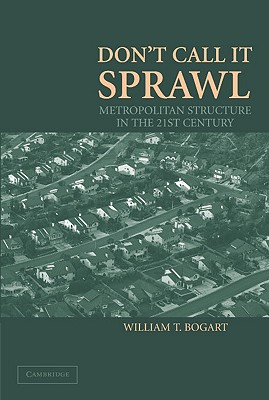
Don''t Call It Sprawl : Metropolitan Structure in the 21st Century
Book Details
Format
Paperback / softback
ISBN-10
052167803X
ISBN-13
9780521678032
Publisher
Cambridge University Press
Imprint
Cambridge University Press
Country of Manufacture
US
Country of Publication
GB
Publication Date
Sep 25th, 2006
Print length
230 Pages
Weight
314 grams
Dimensions
15.20 x 22.70 x 1.00 cms
KSh 5,300.00
Currently unavailable
0 in stock
Delivery Location
Delivery fee: Select location
Secure
Quality
Fast
Bogart puts the current policy debate over urban sprawl into a broader analytical context. He explains economic ideas about the structure of metropolitan areas to people interested in understanding the pattern of growth in their city. It then uses these ideas to analyze the impact and effectiveness of various policies.
In Don't Call It Sprawl, the current policy debate over urban sprawl is put into a broader analytical and historical context. The book informs people about the causes and implications of the changing metropolitan structure rather than trying to persuade them to adopt a panacea to all perceived problems. Bogart explains modern economic ideas about the structure of metropolitan areas to people interested in understanding and influencing the pattern of growth in their city. Much of the debate about sprawl has been driven by a fundamental lack of understanding of the structure, functioning, and evolution of modern metropolitan areas. The book analyzes ways in which suburbs and cities (trading places) trade goods and services with each other. This approach helps us better understand commuting decisions, housing location, business location, and the impact of public policy in such areas as downtown redevelopment and public school reform.
Get Don''t Call It Sprawl by William T. Bogart at the best price and quality guaranteed only at Werezi Africa's largest book ecommerce store. The book was published by Cambridge University Press and it has 230 pages.
Customers Who Bought This Also Bought

Crook Manifesto
KSh 2,700.00
Behind the Beautiful Forevers
KSh 2,000.00

The Keeper
KSh 1,800.00

Africa Is Not A Country
KSh 2,350.00

Slash and Burn
KSh 2,150.00

Slouching Towards Bethlehem
KSh 1,800.00

Strange Weather in Tokyo
KSh 1,800.00

The Coffeehouse
KSh 2,400.00

Heart of the Night
KSh 1,950.00

The Keeper
KSh 3,200.00

Frankenstein Urbanism
KSh 7,900.00
Amnesty
KSh 3,750.00


