
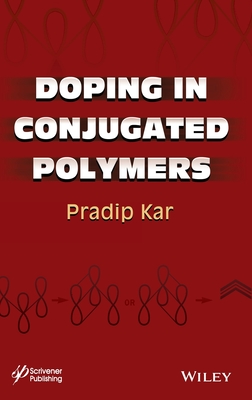
Doping in Conjugated Polymers
by
Pradip Kar
Book Details
Format
Hardback
Book Series
Polymer Science and Plastics Engineering
ISBN-10
1118573803
ISBN-13
9781118573808
Publisher
John Wiley & Sons Inc
Imprint
Wiley-Scrivener
Country of Manufacture
US
Country of Publication
GB
Publication Date
Oct 11th, 2013
Print length
176 Pages
Weight
431 grams
Dimensions
23.60 x 15.50 x 2.00 cms
Product Classification:
Plastics & polymers technologyPlastics and polymers
KSh 20,850.00
Currently unavailable
0 in stock
Delivery Location
Delivery fee: Select location
Secure
Quality
Fast
This book responds to the growing interest in conjugated polymer-dopant interaction across disciplines. The first book dedicated to the subject, it offers an A to Z overview, detailing doping interaction, dopant types, doping techniques, influence of dopant on applications, and more.
An A-to-Z of doping including its definition, its importance, methods of measurement, advantages and disadvantages, properties and characteristics—and role in conjugated polymers The versatility of polymer materials is expanding because of the introduction of electro-active behavior into the characteristics of some of them. The most exciting development in this area is related to the discovery of intrinsically conductive polymers or conjugated polymers, which include such examples as polyacetylene, polyaniline, polypyrrole, and polythiophene as well as their derivatives. "Synmet" or "synthetic metal" conjugated polymers, with their metallic characteristics, including conductivity, are of special interest to researchers. An area of limitless potential and application, conjugated polymers have sparked enormous interest, beginning in 2000 when the Nobel Prize for the discovery and development of electrically conducting conjugated polymers was awarded to three scientists: Alan J. Heeger, Alan G. MacDiarmid, and Hideki Shirakawa. Conjugated polymers have a combination of properties—both metallic (conductivity) and polymeric; doping gives the conjugated polymer's semiconducting a wide range of conductivity, from insulating to low conducting. The doping process is a tested effective method for producing conducting polymers as semiconducting material, providing a substitute for inorganic semiconductors. Doping in Conjugated Polymers is the first book dedicated to the subject and offers a comprehensive A-to-Z overview. It details doping interaction, dopant types, doping techniques, and the influence of the dopant on applications. It explains how the performance of doped conjugated polymers is greatly influenced by the nature of the dopants and their level of distribution within the polymer, and shows how the electrochemical, mechanical, and optical properties of the doped conjugated polymers can be tailored by controlling the size and mobility of the dopants counter ions. The book also examines doping at the nanoscale, in particular, with carbon nanotubes. Readership The book will interest a broad range of researchers including chemists, electrochemists, biochemists, experimental and theoretical physicists, electronic and electrical engineers, polymer and materials scientists. It can also be used in both graduate and upper-level undergraduate courses on conjugated polymers and polymer technology.
Get Doping in Conjugated Polymers by Pradip Kar at the best price and quality guaranteed only at Werezi Africa's largest book ecommerce store. The book was published by John Wiley & Sons Inc and it has 176 pages.
Customers Who Bought This Also Bought

Polymer and Supramolecular Gels
KSh 37,600.00

Ion Beam Treatment of Polymers
KSh 27,900.00
Emissive Materials - Nanomaterials
KSh 45,000.00

Semiconducting Fibers
KSh 10,100.00

Fuel Cells I
KSh 45,000.00
Photoresponsive Polymers II
KSh 32,400.00
Wood Polymer Composites
KSh 32,400.00
Printed Organic and Molecular Electronics
KSh 36,000.00

Carbon Nanotubes for Polymer Reinforcement
KSh 52,200.00

Biosynthetic Polymers for Medical Applications
KSh 31,150.00

Carbon Related Materials
KSh 25,200.00
Polymer Nanocomposites Based on Silver Nanoparticles
KSh 36,000.00
