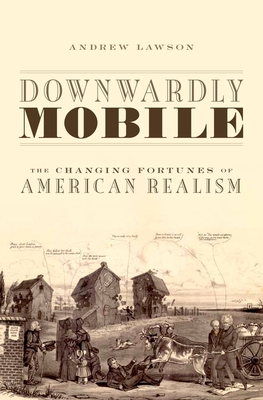
Downwardly Mobile : The Changing Fortunes of American Realism
Book Details
Format
Paperback / softback
ISBN-10
019937502X
ISBN-13
9780199375028
Publisher
Oxford University Press Inc
Imprint
Oxford University Press Inc
Country of Manufacture
GB
Country of Publication
GB
Publication Date
May 22nd, 2014
Print length
208 Pages
Weight
312 grams
Dimensions
15.80 x 23.50 x 1.30 cms
KSh 6,300.00
Temporarily out of stock, due soon
0 in stock
Delivery Location
Delivery fee: Select location
Secure
Quality
Fast
Combining economic history and literary analysis to powerful effect, Downwardly Mobile shows how the fluctuating fortunes of the American middle class forced the emergence of a new kind of literature, while posing difficult political choices about how the middle class might remedy its precarious condition.
In the unstable economy of the nineteenth-century, few Americans could feel secure. Paper money made values less tangible, while a series of financial manias, panics, and depressions clouded everyday life with uncertainty and risk. In this groundbreaking study, Andrew Lawson traces the origins of American realism to a new structure of feeling: the desire of embattled and aspiring middle class for a more solid and durable reality.The story begins with New England authors Susan Warner and Rose Terry Cooke, whose gentry-class families became insolvent in the wake of the 1837 Panic, and moves to the western frontier, where the early careers of Rebecca Harding Davis and William Dean Howells were shaped by a constant struggle for social position and financial security. We see how the pull of downward social mobility affected even the outwardly successful, bourgeois family of Henry James in New York, while the drought-stricken wheat fields of Iowa and South Dakota produced the most militant American realist, Hamlin Garland. For these writers, realism offered to stabilize an uncertain world by capturing it with a new sharpness and accuracy. It also revealed a new cast of social actors-factory workers, slaves, farm laborers, the disabled, and the homeless, all victims of an unregulated market.Combining economic history and literary analysis to powerful effect, Downwardly Mobile shows how the fluctuating fortunes of the American middle class forced the emergence of a new kind of literature, while posing difficult political choices about how the middle class might remedy its precarious condition.
Get Downwardly Mobile by Andrew Lawson at the best price and quality guaranteed only at Werezi Africa's largest book ecommerce store. The book was published by Oxford University Press Inc and it has 208 pages.
Customers Who Bought This Also Bought

The Picture of Dorian Gray
KSh 1,250.00

Pride and Prejudice
KSh 1,150.00

Moby-Dick
KSh 1,750.00
Emma
KSh 1,350.00

The Karamazov Brothers
KSh 2,100.00

Persuasion
KSh 1,100.00

Bleak House
KSh 2,150.00

What Matters in Jane Austen?
KSh 2,700.00

A Tale of Two Cities
KSh 1,200.00

Little Women
KSh 1,550.00

David Copperfield
KSh 2,100.00

Mansfield Park
KSh 1,250.00