
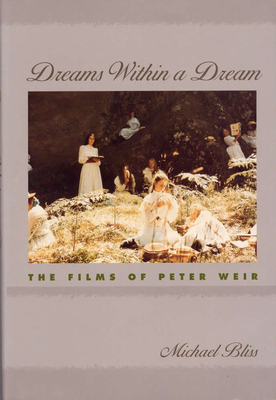
Dreams Within a Dream : The Films of Peter Weir
Book Details
Format
Hardback
ISBN-10
0809322846
ISBN-13
9780809322848
Publisher
Southern Illinois University Press
Imprint
Southern Illinois University Press
Country of Manufacture
US
Country of Publication
GB
Publication Date
Jan 31st, 2000
Print length
240 Pages
Weight
623 grams
Dimensions
23.70 x 16.30 x 2.50 cms
Product Classification:
Individual film directors, film-makersIndividual film directors, film-makers
KSh 7,200.00
Currently unavailable
0 in stock
Delivery Location
Delivery fee: Select location
Secure
Quality
Fast
In considering the films of Peter Weir, this text looks to the filmmaker's Australian heritage. The author also looks to Freud and Jung, whom Weir has studied, to examine why many of Weir's films involve archetypal journeys heading through conflict to spiritual unity.
What we see, and what we seem, are but a dream, a dream within a dream. Michael Bliss views Miranda''s voice-over at the beginning of ""Picnic at Hanging Rock"" as so pivotal in explaining the films of Peter Weir that he borrows her words to create the title of his own study of the Australian filmmaker''s work. Bliss views Weir as an artist whose values are rooted in the realm of the dream, of the unconscious. Surrealistic in technique, Weir avoids the pedestrian assurances of a material realm in favour of an irresolution that, while potentially frustrating, is nonetheless for him a more truthful representation of what he considers reality. For Weir, as for Plato, Bliss demonstrates, ""empirical reality is nothing more than a shadow of what is real"". Bliss also considers Weir''s heritage. Australian cinema, Bliss explains, is characterized by melodramatic narratives born of a desire to see good and evil portrayed in striking opposition. Weir, for example, dramatizes the contradictory forces of light versus darkness, reason versus mystery, and rationality versus magic in such films as ""Picnic at Hanging Rock"" and ""The Last Wave"". This melodramatic emphasis is evident as well in the polarized characterizations in such films as ""Witness"", ""Dead Poets Society"", and ""The Truman Show"". Bliss also discusses Weir''s use of another staple of Australian cinema - ""mateship"", the celebration of the bond between male companions. But by making self-knowledge dependent on action involving one''s friends, Weir gives mateship a new meaning. Moreover, like other Australian filmmakers, Weir emphasizes the starkness of the Australian landscape, which functions either as a hazard or a deadly challenge, at least until American mythology caused him to see nature in a more positive light. Also prominent in Weir''s films is an Australian spirit of rebellion coupled with the Aussie ambivalence toward all aspects of British culture. To help explain Weir''s films, Bliss looks to Freud and Jung, whom Weir has studied, and also to two other prominent purveyors of myth and archetype, Northrop Frye and Joseph Campbell. Virtually all Weir characters struggle toward a new mode of awareness, a psychological awareness based on archetypal truths. Many of his films involve archetypal journeys heading through conflict to spiritual unity. Weir''s quest is to find out what we really know and how we know what we know
Get Dreams Within a Dream by Michael Bliss at the best price and quality guaranteed only at Werezi Africa's largest book ecommerce store. The book was published by Southern Illinois University Press and it has 240 pages.
Customers Who Bought This Also Bought

Oromay
KSh 2,350.00

Director
KSh 3,950.00

Oromay
KSh 3,600.00

Fassbinder Thousands of Mirrors
KSh 2,350.00

Anytime
KSh 2,000.00

I Feel Bad About My Neck
KSh 2,000.00

I Feel Bad About My Neck
KSh 2,700.00

Most of Nora Ephron
KSh 2,000.00
Dark Matter
KSh 3,600.00

Greta Gerwig’s Barbie
KSh 4,700.00

Infamous Players
KSh 3,850.00

The Crying Game
KSh 2,350.00
More by Michael Bliss

Banting
KSh 5,050.00

The Making of Modern Medicine
KSh 4,300.00
Peckinpah Today
KSh 4,500.00

Writing History
KSh 4,200.00

Laurel and Hardy''s Comic Catastrophes
KSh 15,500.00
The Discovery of Insulin
KSh 4,700.00

Invasions USA
KSh 8,100.00

What Goes Around Comes Around
KSh 2,700.00

What Goes Around Comes Around
KSh 3,950.00

Justified Lives
KSh 6,850.00
Between the Bullets
KSh 12,550.00

William Osler
KSh 7,100.00
