
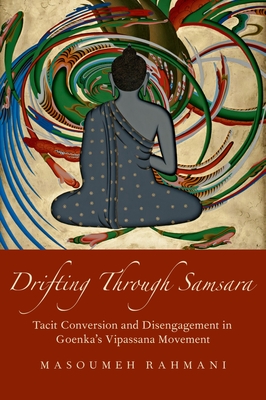
Drifting through Samsara : Tacit Conversion and Disengagement in Goenka's Vipassana Movement
Book Details
Format
Hardback
Book Series
AAR Academy Series
ISBN-10
0197579965
ISBN-13
9780197579961
Publisher
Oxford University Press Inc
Imprint
Oxford University Press Inc
Country of Manufacture
US
Country of Publication
GB
Publication Date
Mar 31st, 2022
Print length
260 Pages
Weight
476 grams
Dimensions
15.00 x 22.40 x 3.10 cms
Product Classification:
Religion & politicsBuddhismAnthropologyReligion and politicsBuddhism
KSh 15,200.00
Currently unavailable
0 in stock
Delivery Location
Delivery fee: Select location
Secure
Quality
Fast
In Drifting Through Samsara, Masoumeh Rahmani provides a fieldwork-based study of Goenka''s Vipassana meditation movement in New Zealand. This group is distinguished by its refusal to identify as Buddhist and by a rich rhetorical repertoire for repackaging Theravada Buddhist teachings in pseudo-scientific and secular language. Drawing from qualitative research, the book examines the way the movement''s discourse shapes unique processes and narratives of conversion and disengagement. Rahmani argues that conversion to this movement is tacit and paradoxically results in the members'' rejection of religious labels and categories including conversion. Tracing the linguistic changes associated with the process of conversion and increased commitment, she outlines three main disengagement pathways: (1) pragmatic leaving, (2) disaffiliation, and (3) deconversion. Pragmatic leavers are individuals who were disengaged prior to developing a commitment. Rahmani argues that the language of these leavers is characterised by pragmatisms, dualistic discourse, and ambivalence, and their post-disengagement involves an active gravitation towards practices with easily accomplished goals. Disaffiliates and deconverts are individuals who disengaged after years of intense commitment to the movement. One of the distinguishing features of disaffiliation narratives is self-doubt resulting from the movement''s ambiguous discourse regarding progress. For these people post-disengagement often involves the retrospective adoption of Buddhist identity.Rahmani finds that as a consequence of its linguistic strategies, deconversion is a rare exit pattern from this movement. In general, however, the themes and characteristics of both disaffiliation and deconversion fit the contours of exit from other traditions, even though conversion was tacit in the first place. The book thus questions the normative participant recruitment approach in conversion studies and argues that a simple reliance on the informants'' identification with or rejection of religious labels fails to encompass the tonalities of conversion in the contemporary spiritual landscape.
Get Drifting through Samsara by Masoumeh Rahmani at the best price and quality guaranteed only at Werezi Africa's largest book ecommerce store. The book was published by Oxford University Press Inc and it has 260 pages.
Customers Who Bought This Also Bought

How Civil Wars Start
KSh 2,000.00

Jesus and the Powers – Christian Political Witness in an Age of Totalitarian Terror and Dysfunctional Democracies
KSh 2,500.00

On Antisemitism
KSh 4,500.00

Jesus and the Powers
KSh 3,050.00

Crime and Punishment in Islamic Law
KSh 10,100.00

Masque of Africa
KSh 2,350.00

Righteous Mind
KSh 2,700.00

Iran
KSh 2,000.00

The Mantle of the Prophet
KSh 3,750.00

Defiance
KSh 3,050.00

The Coming Storm
KSh 2,850.00

Antisemitism
KSh 2,350.00
More in This Genre
How Civil Wars Start
KSh 2,000.00
Jesus and the Powers – Christian Political Witness in an Age of Totalitarian Terror and Dysfunctional Democracies
KSh 2,500.00
On Antisemitism
KSh 4,500.00
Jesus and the Powers
KSh 3,050.00
Crime and Punishment in Islamic Law
KSh 10,100.00
Masque of Africa
KSh 2,350.00
