
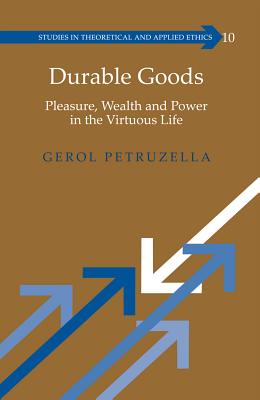
Book Details
Format
Hardback
Book Series
Studies in Theoretical & Applied Ethics
ISBN-10
1433116995
ISBN-13
9781433116995
Edition
New
Publisher
Peter Lang Publishing Inc
Imprint
Peter Lang Publishing Inc
Country of Manufacture
US
Country of Publication
GB
Publication Date
Apr 12th, 2013
Print length
177 Pages
Weight
506 grams
Dimensions
23.40 x 15.60 x 1.60 cms
KSh 11,600.00
Currently unavailable
0 in stock
Delivery Location
Delivery fee: Select location
Secure
Quality
Fast
Ancient Greek philosophers generally accept the claim that eudaimonia is within our power to achieve, regardless of circumstance. This text provides a comprehensive linguistic and ethical analysis of key terms and arguments across several centuries of ancient Greek ethical thought on this fascinating topic.
Ancient Greek philosophers generally accept the claim that e?da?µ???a is within our power to achieve, regardless of circumstance. Conversely, external goods – physical health, education, social standing – are frequently present or absent due to circumstances beyond our control. Can eudaimonism explain how more than a privileged elite can attain e?da?µ???a when so few enjoy the requisite external goods?
A satisfactory account of the relation between external goods and well-being must accommodate both the insight that there is an essential connection between prosperity and the flourishing life and that there is a real sense in which e?da?µ???a is a self-sufficient concept. The «applied intellectualist» interpretation of eudaimonism defended here accommodates important insights of several ancient Greek traditions: Aristotle’s account of human nature, specifically the role of external goods as necessary preconditions for leading a human life; Socratic and Stoic analysis that external goods are necessary constituents of moral action; and Plato’s commitment to a criterion for judging the compatibility of external prosperity with a life of e?da?µ???a.
This text provides a comprehensive linguistic and ethical analysis of key terms and arguments across several centuries of ancient Greek ethical thought on this fascinating topic, making it an excellent foundation for an upper-division undergraduate seminar in ancient Greek ethics, virtue ethics, or applied ethics.
A satisfactory account of the relation between external goods and well-being must accommodate both the insight that there is an essential connection between prosperity and the flourishing life and that there is a real sense in which e?da?µ???a is a self-sufficient concept. The «applied intellectualist» interpretation of eudaimonism defended here accommodates important insights of several ancient Greek traditions: Aristotle’s account of human nature, specifically the role of external goods as necessary preconditions for leading a human life; Socratic and Stoic analysis that external goods are necessary constituents of moral action; and Plato’s commitment to a criterion for judging the compatibility of external prosperity with a life of e?da?µ???a.
This text provides a comprehensive linguistic and ethical analysis of key terms and arguments across several centuries of ancient Greek ethical thought on this fascinating topic, making it an excellent foundation for an upper-division undergraduate seminar in ancient Greek ethics, virtue ethics, or applied ethics.
Get Durable Goods by Gerol Petruzella at the best price and quality guaranteed only at Werezi Africa's largest book ecommerce store. The book was published by Peter Lang Publishing Inc and it has 177 pages.
Customers Who Bought This Also Bought
The Odyssey
KSh 1,800.00
The Odyssey
KSh 1,600.00
The Divine Comedy
KSh 2,350.00
Annals
KSh 2,350.00
Classical Literary Criticism
KSh 2,350.00
Great Dialogues of Plato
KSh 1,450.00
The Divine Comedy
KSh 2,700.00
The Iliad
KSh 1,800.00

The Masnavi, Book Six
KSh 2,000.00

The Masnavi, Book Five
KSh 1,800.00
Chaucer's Pardoner and Gender Theory
KSh 8,100.00
Classical Literary Criticism
KSh 1,800.00
